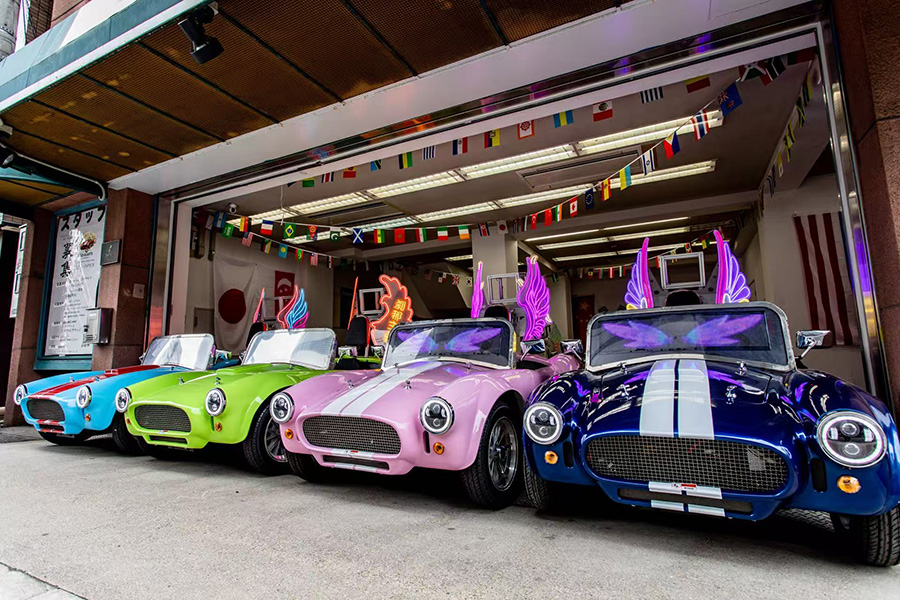
W Go-Kart Osaka offers two route identities for visitors comparing go kart tours in Osaka. Choose the daytime Castle loop when a broad landmark perspective is the priority: its published map shows approximately 12.6 kilometres and 48 minutes. Choose the Tsutenkaku city loop when illuminated Minami and Shinsekai streets are the desired backdrop: its map shows approximately 8.9 kilometres and 46 minutes and the operator recommends it at night.
Both are approximately one-hour, guide-led electric-kart experiences on public roads. Both begin and end at 3 Chome-5-2 Shinmachi. Neither promises a stop at every named place. The useful comparison is therefore not “Which route is objectively better?” but “Which Osaka view do I want to experience while driving?”
Go kart tours in Osaka divide into two visual families
The maps show a longer Castle-oriented loop and a more compact city route through or near well-known southern districts. Distance alone does not measure visual value. One route gives the day a historical-landmark anchor; the other connects several dense entertainment areas into a night drive. The table keeps the published facts separate from the choice each fact supports.
| Decision question | Castle loop | Tsutenkaku city loop |
|---|---|---|
| Preferred setting | Daytime landmark context | Night streets, signs and illuminated districts |
| Published map | Approx. 12.6 km / 48 min | Approx. 8.9 km / 46 min |
| Operator recommendation | Daytime | Night |
| Best fit | A visitor building a Castle-focused city chapter | A visitor drawn to Minami and Shinsekai atmosphere |
| Do not assume | Museum admission or a park stop | Drop-off in Namba or entry to Tsutenkaku |
The Castle loop frames one major landmark at city scale
Official Osaka tourism presents Osaka Castle Park as a large area containing the museum, garden and other facilities. W Go-Kart Osaka’s route uses the Castle identity for a moving road experience; it does not combine those facilities into the tour. This route suits a traveller who wants a broad daytime impression and can schedule any detailed park visit independently.
The city loop connects several neighbourhood identities
The operator’s map names or passes through the wider context of Amerikamura, Shinsaibashi, Dotonbori, Namba/Nipponbashi, Ebisucho and Shinsekai before the Tsutenkaku area. Official tourism describes Dotonbori as a Minami shopping and entertainment district and Shinsekai as the area associated with Tsutenkaku. These sources explain the place identities, not a guaranteed turn-by-turn path.
A two-minute mapped difference does not rank the experiences
The map values differ by only about two minutes, while the distances differ more visibly. Public traffic prevents either number from becoming a performance score. Choose the 48-minute depiction for its Castle orientation, not because longer must mean better; choose the 46-minute depiction for the concentration of night districts, not because shorter must mean easier.
Choose the Castle route when daylight tells the story you want
Daylight can make the kart drive feel like an active sightseeing interval between other daytime attractions. The operator publishes starts from 10:00 and recommends the Castle loop during the day. The route works especially well when the visitor accepts movement as the product and treats any admission-based Castle activity as separate.
A first Osaka visit may need one clear daytime anchor
A traveller with many disconnected plans can use the Castle loop as a single city-scale chapter. The mapped route provides a defined purpose without requiring the guest to design roads independently. After returning to Shinmachi, the person can decide whether the Castle impression is enough or whether a park visit deserves another block of time.
A history-focused traveller should protect a separate walking visit
The guide leads a kart group; the product is not a museum lecture or garden tour. If exhibits, architecture or long observation matter, the reader should check current facility details and travel from the base after the drive. The daytime Castle-loop guide explains how to keep those two chapters from colliding.
A daytime photographer must accept the moving viewpoint
Guests should not handle a phone while driving, and the route does not promise staging at a particular landmark. A 360 camera is listed as a JPY 1,000 option before 20:00, subject to the operator’s current arrangement, but it does not turn the street into a photo set. Choose the Castle route for the experience of movement; return on foot for composed images.
Choose the city route when Osaka after dark is the main subject
The Tsutenkaku city loop is not merely the Castle loop at a later hour. Its map centres southern districts whose signs, streets and entertainment identity become part of the night view. The operator recommends this route at night and publishes a Night Experience for starts at 20:00, 21:00 and 22:00.
Minami gives the route a sequence of changing street character
Amerikamura is associated with youth culture, while Dotonbori is known for prominent signs, food and entertainment. Namba and Nipponbashi add further urban context before the route continues toward Ebisucho and Shinsekai. The tour lets those identities unfold from the kart; it does not include shopping time, dining or a walking stop in each area.
Shinsekai and Tsutenkaku give the night loop its visual endpoint
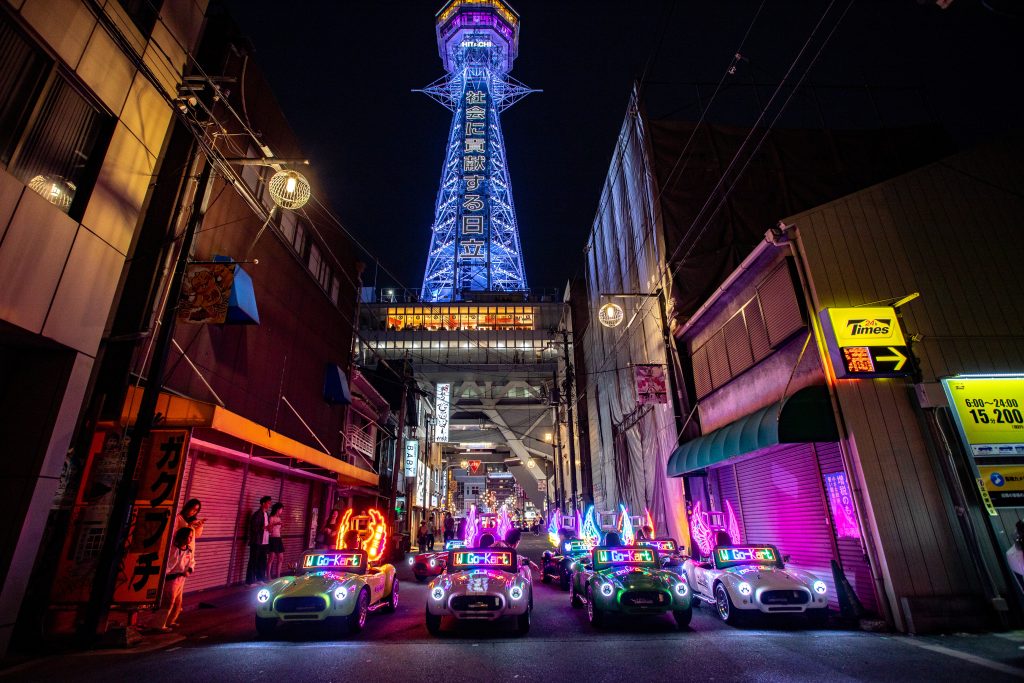
Official visitor information places Tsutenkaku within Shinsekai and describes views that differ by day and night. W Go-Kart Osaka’s genuine night photograph shows karts beneath the illuminated tower area, supporting the route’s after-dark character. It still does not promise observatory admission, a specific traffic-free frame or a stop beneath the tower.
A nightlife plan should put alcohol after the driving
The city route can lead into dining or entertainment after the group returns to Shinmachi. Drivers should remain sober and attentive throughout the road portion. The attraction of Dotonbori or Shinsekai food does not change that order: complete the guided drive, return the kart, then continue by walking or other non-driving transport.
The shared service frame matters more than the route difference
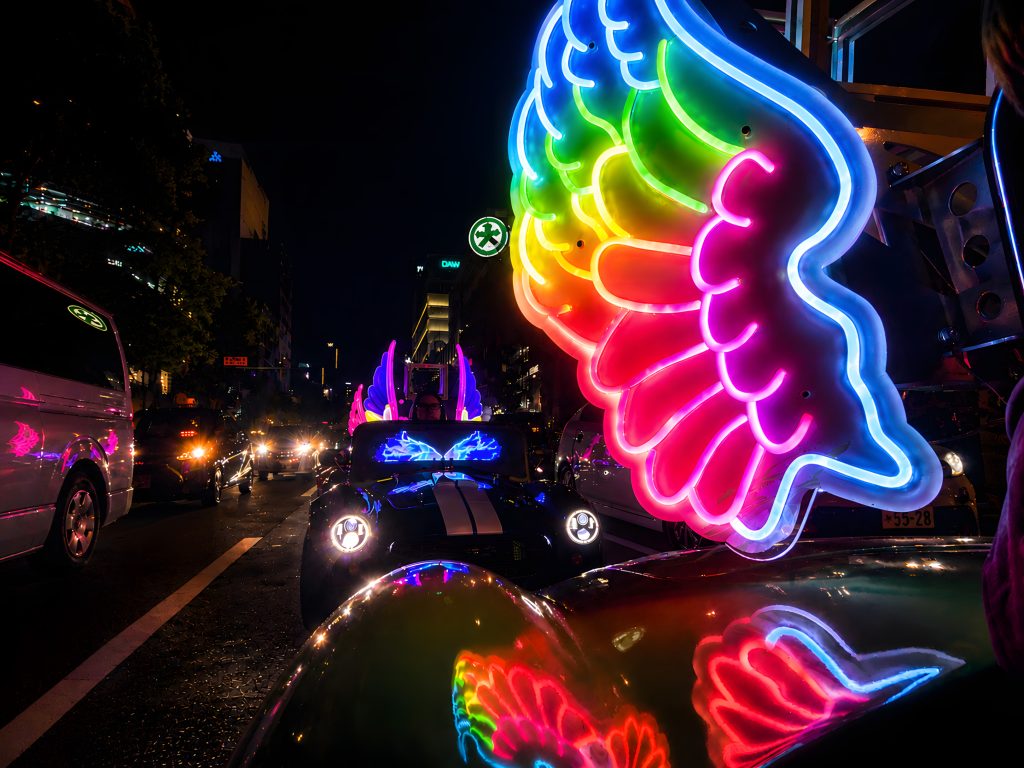
Once the view is chosen, both options return to the same operating foundation. Guests arrive ten minutes early at the staffed Shinmachi base, present accepted originals, receive a briefing, follow the guide on public roads and return to the shop. Insurance, guide and costume are included in the approximately one-hour service.
The same three licence paths govern both maps
A valid Japanese licence is one path. The second is an original 1949 Geneva Convention IDP plus original domestic licence and passport. The third is an accepted foreign licence plus an authorized Japanese translation and passport for the jurisdictions named by the operator. Route preference never cures an incomplete document set; the licence guide should be checked first.
The same road behaviour follows the group from day into night
Japan’s left-side traffic, signals and pedestrian priority do not disappear when signs illuminate. Drivers should wear closed-toe shoes and comfortable clothing, listen to the guide and avoid phone use while operating the kart. Darkness changes visibility and atmosphere, not the duty to follow ordinary road rules.
The same Shinmachi return prevents either route becoming transport
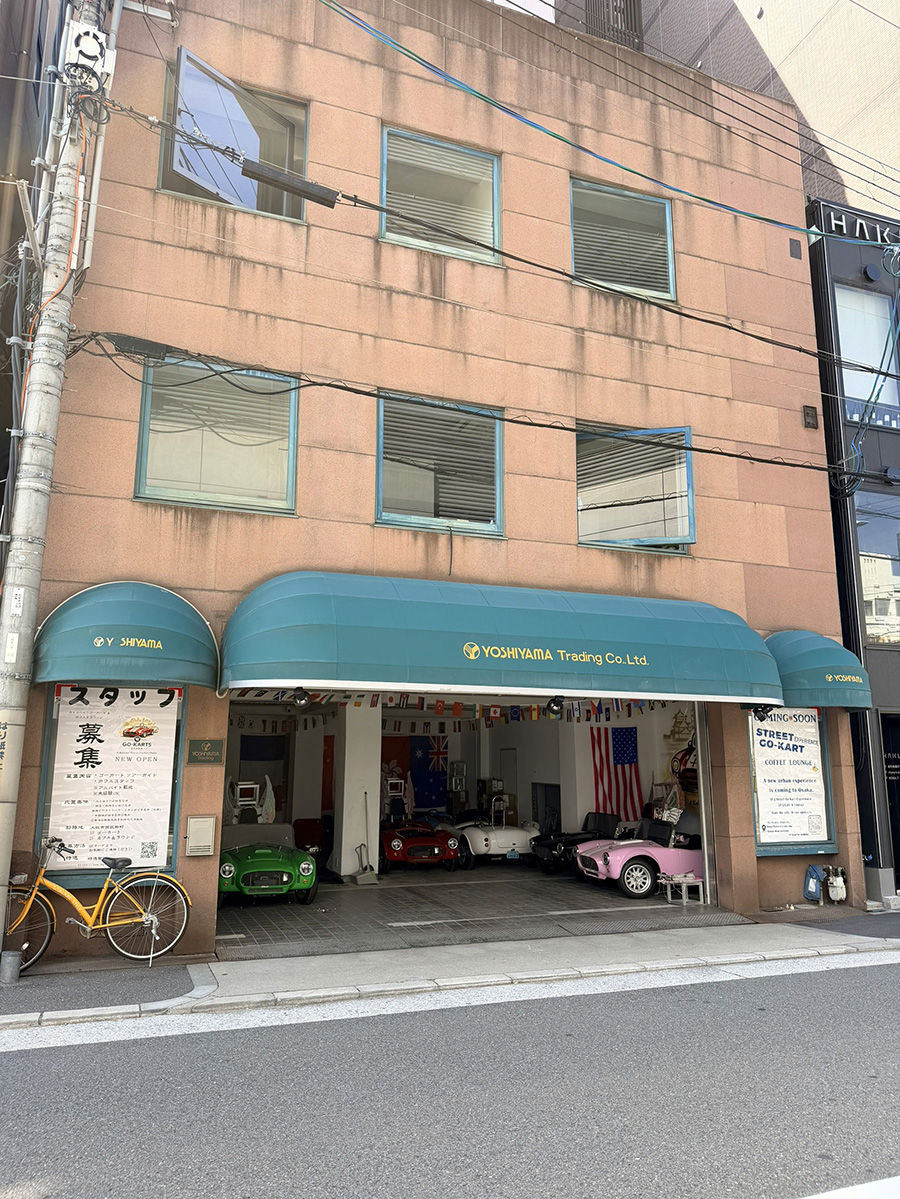
Castle, Namba and Tsutenkaku are route identities, not drop-off locations. Every onward meal, station or attraction begins after the kart comes back to 3 Chome-5-2 Shinmachi. The shop is published as roughly 3–5 minutes from Nishiohashi Station, 8–10 minutes from Nishi-Nagahori and about 10 minutes from Shinsaibashi.
Price bands can reinforce—but should not replace—the view decision
The published price is JPY 7,000 for starts from 10:00 through 16:00, JPY 10,000 at 17:00–19:00, and JPY 13,000 for the Night Experience at 20:00–22:00. All include the approximately one-hour service, insurance, guide and costume. These bands align naturally with the operator’s day/night route recommendations, but price alone does not tell a visitor which city story they prefer.
Day and evening route prices leave the three add-ons separate
Coffee is listed at JPY 500, a speaker at JPY 500 and a 360 camera at JPY 1,000. A 17:00, 18:00 or 19:00 start therefore carries the JPY 10,000 base while leaving these items separate. Light changes seasonally, so an evening booking should not be sold to oneself as a guaranteed sunset product.
At 20:00, the Night Experience bundles the extras
The JPY 13,000 night package includes coffee, speaker and 360 camera. That commercial difference can support a buyer already committed to the night city view. It should not persuade a Castle-focused visitor to abandon the daytime subject they actually want. The night-start guide compares how the three late starts fit an evening.
Cancellation terms apply after the route vote is settled
Customer cancellation is free until 48 hours before the scheduled tour. Inside that period, it is non-refundable, and rescheduling depends on availability. Unsafe-weather cancellation by the operator follows the published refund or no-cost reschedule terms. Agree on route identity before payment rather than use the cancellation window to postpone the basic group decision.
Conflicting visual priorities can be resolved without calling one route best
Ask each driver to choose one sentence: “I want a broad daytime Castle chapter” or “I want Minami and Shinsekai after dark.” If the group splits, look at the rest of the Osaka trip. A separate Castle Park day can free the kart for night; a separate Dotonbori walk can free it for daytime. The city offers other ways to cover the view not chosen.
Do not book both merely because the query uses a plural
“Tours” can mean available options rather than a recommendation to purchase twice. The website does not publish a two-route bundle, repeat-driver discount or combined itinerary. A visitor may independently book what the live form permits, but one well-matched route often answers the actual visual goal without inventing an unpublished package.
Do not let one famous place obscure the rest of the loop
The Castle label does not mean entry to one building; the Tsutenkaku label does not mean a single tower photograph. Both are city loops. A good choice considers the character around the anchor, the day/night recommendation and the shared public-road format. That broader reading is more faithful to the mapped experience.
Select go kart tours in Osaka by view, then verify the booking facts
After choosing Castle/day or city/night, compare the exact current price and inclusions in the price guide. Confirm every driver’s original documents. Then use the booking form for the available date, hourly start, guest count and route/price selection. The one-to-seven selector is not a fleet or availability guarantee.
Arrive early, preserve travel time after the Shinmachi return and keep third-party attraction plans independent. If weather becomes unsafe, follow the operator’s current communication and published terms rather than infer that a visually attractive route must operate. The mapped identity helps choose; actual road and weather conditions still govern delivery.
Route information checked on 24 August 2026: maps, recommendations, distances, times, start bands, prices, inclusions, address, documents and policies were checked on W Go-Kart Osaka pages. Official Osaka tourism is used only for broad district identities. No turn-by-turn road, guaranteed visibility, traffic condition, landmark stop, attraction entry, route bundle, fleet size or exact finish is claimed.
The strongest route is the one whose visual promise matches the traveller’s reason for driving. W Go-Kart Osaka makes that choice unusually legible through two maps, published measurements, clear day/night recommendations and transparent packages. Pick the Castle loop for a daytime landmark chapter or the Tsutenkaku city loop for southern Osaka after dark—then let the guide, the electric kart and the real streets deliver that chosen perspective.