A reliable go kart tour Osaka booking makes three choices agree: route, start time, and actual driver count. Select the Castle loop for the operator’s daytime-oriented historical route or the Tsutenkaku city loop for its night-oriented Minami/Shinsekai context. Then attach the correct price band and count only participants who can present an accepted original licence set.
The booking form asks for name, email, date, time, number of guests from one to seven, and route tier. Those fields are not independent boxes. A city-night expectation entered with a daytime plan, seven guests entered before seven document paths are verified, or a Namba itinerary that ignores the Shinmachi check-in creates a conflict before payment.
A go kart tour Osaka booking has three coupled edges
| Booking edge | Question it must answer | Common conflict |
|---|---|---|
| Route ↔ time | Does the city subject fit the selected part of day? | Neon expectation attached to an early Castle plan |
| Time ↔ price | Does the party understand the per-person band and inclusions? | JPY 10,000 assumed for a 20:00 start |
| Guests ↔ documents | Can every counted participant drive independently? | One ineligible friend counted as a future passenger |
The route-time edge selects the city story
The Castle map is approximately 12.6 kilometres and 48 mapped minutes and is recommended in daytime. The Tsutenkaku city map is approximately 8.9 kilometres and 46 mapped minutes and is recommended at night. Official tourism treats Osaka Castle Park and Dotonbori/Minami as different visitor subjects; it does not define W Go-Kart Osaka’s roads.
The time-price edge selects the commercial package
Starts at 10:00–16:00 cost JPY 7,000 per person, 17:00–19:00 cost JPY 10,000, and 20:00–22:00 cost JPY 13,000. Every band includes approximately one hour, guide, insurance, and costume. Night includes coffee, speaker, and 360 camera; before 20:00 they are separately priced.
The guest-document edge selects the real driving party
Every participant drives independently. The site publishes no passenger or spectator ride. The one-to-seven selector describes the requested party, but it does not prove fleet capacity, simultaneous availability, or eligibility. Count a person only after their physical document path has been checked.

The Castle route needs a daytime-compatible itinerary
A Castle-led booking is strongest when the party wants historical orientation and can place separate park or museum depth around the drive. The route name does not include attraction entry, parking, a guaranteed stop, or guide commentary. The service begins and returns in Shinmachi rather than at the Castle grounds.
A 10:00 start requires earlier Shinmachi readiness
Ten o’clock is the first published start. Guests are asked to arrive ten minutes early, so breakfast, train travel, street navigation, and document retrieval must finish before reception. The operator estimates three to five minutes from Nishiohashi, eight to ten from Nishi-Nagahori, and about ten from Shinsaibashi; these are not total hotel journey times.
A 14:00 start can sit between two depth activities
A party might walk Osaka Castle Park in the morning and book the kart later, or drive first and visit a separate attraction afterward. The exact order depends on current facility hours and transport. Do not use the route’s 48 mapped minutes as an exact finish or assume the service includes museum time.
A Castle request should not carry a night-city image promise
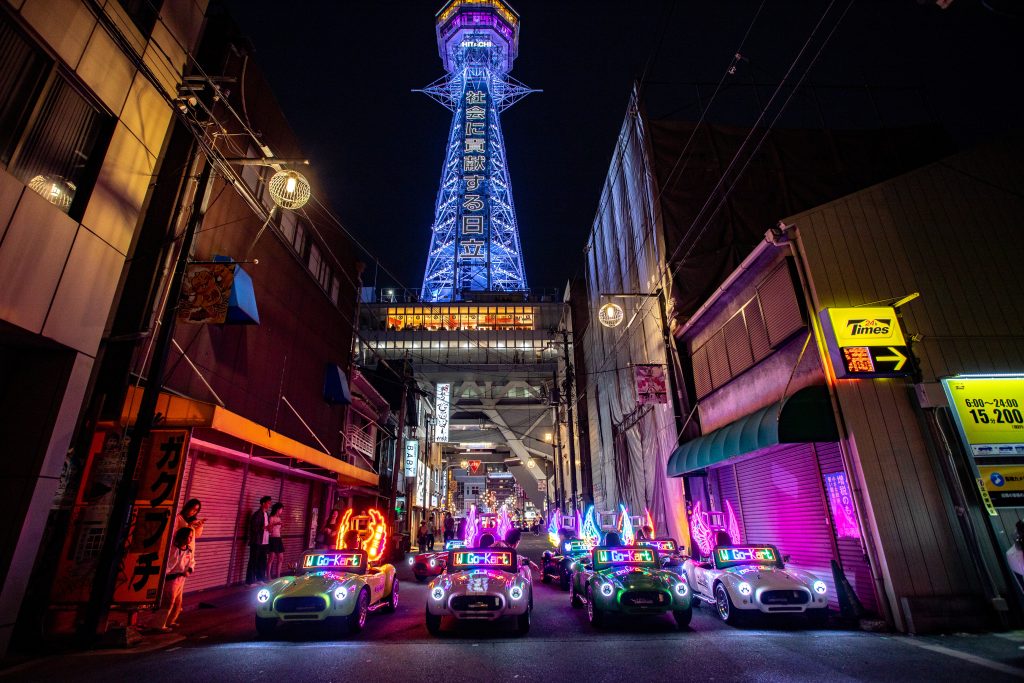
The current media library has authentic night-route imagery but no confirmed Castle-route action image. A coordinator should not attach the Tsutenkaku photograph to a Castle booking and describe it as representative of that road. The route identity is supported by the operator’s map, while exact Castle sightlines remain unpublished.
The city route needs a Minami-compatible evening
The Tsutenkaku city map passes through or near Amerikamura, Shinsaibashi, Dotonbori, Namba/Nipponbashi, Ebisucho, and Shinsekai/Tsutenkaku. The service is a moving guided loop, not dinner, shopping, tower admission, or one-way nightlife transport. Build those activities before or after the Shinmachi return.
A 17:00–19:00 start keeps the extras optional
This band costs JPY 10,000 per person. Coffee is JPY 500, the speaker JPY 500, and the 360 camera JPY 1,000 before 20:00. A party can choose only the core service and costume or add an item with a clear purpose. Darkness and exact city lighting vary by season and weather.
A 20:00–22:00 start includes the three published extras
The JPY 13,000 Night Experience includes coffee, speaker, and camera. Inclusion does not promise coffee specifications, music method, camera output, costume stock, exact views, or stops. The coordinator should sell the group a late guided city drive, not a guaranteed media package.
A dinner booking must survive the same-base return
The group does not finish in Namba or Tsutenkaku. If dinner comes after the drive, calculate current transport from Shinmachi and leave space around the approximately one-hour service. If dinner comes first, allow payment, walking, and station uncertainty before the ten-minute-early arrival.
The driver roster is more important than the guest selector
Japanese-licence drivers form the direct path
A valid Japanese driver’s licence is the domestic accepted route. The person still needs to be present, dressed appropriately, and able to follow the briefing. A coordinator cannot use one person’s licence to cover another name in the guest count.
Geneva-permit drivers need three originals per person
The accepted international path uses an original 1949 Geneva Convention permit, original domestic licence, and passport. Verify issuer, convention, validity, and physical possession. A permit alone, domestic licence alone, or phone photograph leaves the edge inconsistent.
Translation-path drivers need the accepted jurisdiction and documents
The operator lists Switzerland, Germany, France, Belgium, Monaco, and Taiwan for an accepted Japanese-translation path with original domestic licence and passport. A translation from an unconfirmed source or a jurisdiction outside the list should not be treated as ready.
The payer and the drivers can have different roles
One person may coordinate and pay for the group, but payment details do not merge the driver records. The booking name and email should remain usable for coordination, while each participant preserves their own legal originals. Successful checkout does not validate the whole roster.
Conflict tests reveal an unstable booking before submission
Couple conflict: Castle depth versus city lights
If one partner wants Castle history and the other wants Dotonbori/Tsutenkaku at night, changing only the start time cannot satisfy both route subjects. Decide which gap the kart should fill and schedule the other interest as a walking or attraction visit. Do not submit a vague route tier and hope staff combine the maps.
Group conflict: six ready drivers and one incomplete permit
The party can delay booking, reduce the requested count to the genuine driving roster, or solve the document path before payment. It should not assume the seventh guest becomes a passenger. The selector’s maximum of seven is not evidence of a passenger seat or of availability at the desired start.
Calendar conflict: 22:00 bundle versus the last connection
Included accessories may attract the group, but a late return can undermine the trip. Work backward from the real hotel or train after Shinmachi. If the onward plan is fragile, choose 20:00, an earlier band, or another date rather than asking approximately one hour to become exact.
Photo conflict: one required landmark image versus live roads
The operator says stopped photo moments are available and guides may help, but it does not publish locations, number, duration, or results. Guests must not take photos while driving. A required Castle or Namba frame belongs in a separate stationary visit, not in the booking’s acceptance criteria.
One changed field should trigger its connected reviews
A coordinator may resolve the triangle and then receive one late message: a friend joins, dinner moves, or the group changes route. Editing only the visible field can create a new contradiction. Follow the changed input across every edge it touches before submitting or requesting a reschedule.
A route change reopens the time and itinerary decisions
Switching from Castle to the Tsutenkaku city loop is not a label correction. It changes the recommended time context and the districts that should receive separate walking depth. Recheck the selected start, package band, dinner sequence, and the images used to explain the plan to the party.
A time change reopens price, transport, and natural-light expectations
Moving from 19:00 to 20:00 changes the published per-person price from JPY 10,000 to JPY 13,000 and changes the extras from optional to included. It also moves the return later. Recalculate the group total, last connection, meal position, and seasonal-light assumption; do not edit only the hour.
A guest-count change reopens documents and arithmetic
Adding one driver changes the per-person multiplication and creates one more eligibility record. It may also affect live availability, which the public selector cannot guarantee. Removing a person changes the total but does not automatically create a credit or cancellation outcome; follow the current operator process and published terms.
A date change reopens validity, weather, and the 48-hour boundary
An international permit, domestic licence, passport, or accepted translation must still be valid and physically available on the new date. Forecast and daylight context can differ. A requested reschedule depends on availability, so do not erase the original trip plan until the changed service is actually confirmed through the operator’s process.
The coordinator should preserve a one-page party record
This is not a new form for the operator; it is the group’s private alignment record. Keep the chosen route identity, booked date/time, per-person band, requested driver count, and Shinmachi address together. Beside each driver, mark only whether their accepted physical set has been personally verified—never copy sensitive document numbers into a casual group chat.
Record route reasons in one sentence
“Castle daytime for historical orientation” or “Tsutenkaku city at night for several Minami/Shinsekai contexts” is enough. A concise reason keeps the group from reopening the choice because of an unrelated photograph. It also exposes a mismatch if the selected form option does not tell the same story.
Record the total as arithmetic, not as a custom quote
Multiply the current listed per-person band by the requested drivers and add only the relevant published options. Mark the calculation date and keep availability separate. This prevents one participant from reading an illustration as a group discount, reserved capacity, or final payment screen.
Record arrival and return against the same address
Write 3 Chome-5-2 Shinmachi on both sides of the service line. Place hotel-to-base travel before it and base-to-dinner or accommodation travel after it. This small symmetry prevents Namba, Castle, or Tsutenkaku from becoming a fictional endpoint when the itinerary is shared.
The booking form should receive resolved decisions
Name and email create the coordination channel
Use a name the arriving party recognizes and an email that remains accessible during travel. The website does not publish an exact response time or a specific confirmation-message format. The coordinator should retain whatever the completed flow actually presents without inventing a status from card activity alone.
Date and time select the price and cancellation clock
The scheduled departure anchors the 48-hour customer-cancellation boundary. Inside it, cancellation is non-refundable; requested rescheduling depends on availability. If unsafe weather makes the operator cancel, current terms provide a refund or no-cost reschedule. A driver’s missing document is not an operator weather cancellation.
Guest count and route tier complete one request
Enter the verified driver roster and the route/time decision the party agreed on. Availability remains live. The site publishes limited participant numbers but no exact fleet or per-start capacity, so the submitted form should be treated as a request within the current process rather than proof of inventory.
Approve the go kart tour Osaka booking when every edge agrees
Use the two-route tour overview to settle the city subject, the start-time guide for the evening bands, and the booking confirmation guide to keep request and completed records distinct.
Verify the original licence paths, then enter the resolved fields in the booking form. Read the commercial disclosure before payment. A strong submission tells one coherent story from route choice through the Shinmachi return.
Booking information checked on 24 August 2026: form fields, route maps, recommendations, starts, prices, inclusions, options, address, access, arrival, documents, Stripe statement, and policies were checked on W Go-Kart Osaka pages. Official tourism supports only distinct area identities. No capacity, availability, confirmation format, response time, exact finish, route merge, photo result, passenger service, or payment-method list is claimed.
A coordinator does not need a complicated system. Route and time should describe the same city experience; time and price should describe the same package; guest count and documents should describe the same people. When all three edges agree, the form becomes a faithful handoff to W Go-Kart Osaka instead of a bundle of unresolved assumptions.