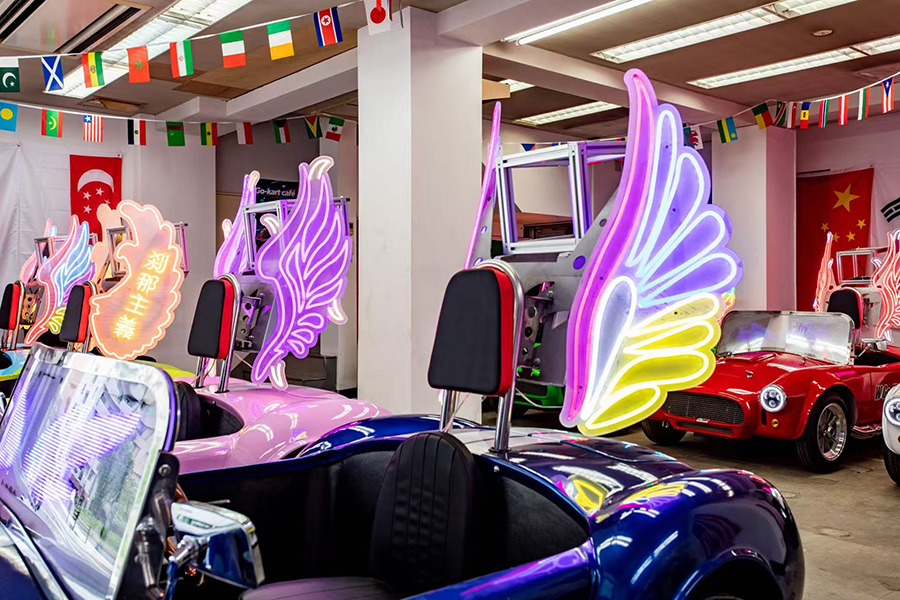
The right Osaka go karting experience depends on the city memory you want to create. Choose W Go-Kart Osaka’s Castle loop in the daytime for a historic landmark, longer mapped route and clearer daylight context. Choose the Tsutenkaku city loop after dark for illuminated karts and the visual density of Shinsaibashi, Dotonbori, Namba and Shinsekai. Both are guided electric public-road tours starting and returning at Shinmachi, so first confirm valid driving documents, route mood and a realistic departure.
W Go-Kart Osaka is a service provider rather than a vehicle-hire counter. Every current price band includes an approximately one-hour experience, insurance, guide and costume. The operator’s live service description presents both routes and the current bands; the booking form then joins the desired date, time, guest count and loop.
An Osaka go karting experience can feel historical or cinematic
The two routes are not simply “long” and “short.” Their recommended light, landmark emphasis and surrounding itinerary create different emotional shapes. The Castle loop works as a daytime view of a historic area. The city loop uses the electric kart lighting and southern commercial districts to make the moving street scene the attraction.
The Castle loop gives one landmark room to define the drive
The operator’s Castle map depicts approximately 12.6 kilometres and about 48 minutes of driving from Shinmachi towards the Osaka Castle area and back. W Go-Kart Osaka recommends this option during the day. The loop suits a traveller who wants one recognisable historical anchor without making the entire tour about nightlife.
Osaka’s official tourism guide describes Osaka Castle Park as a large central park containing historic buildings and seasonal landscapes. That broader context explains why daylight can add visual depth around the area. The kart route does not include park admission, a visit inside the museum or a guaranteed stop at a particular gate.
The city loop lets several districts build the atmosphere together
The Tsutenkaku route map depicts approximately 8.9 kilometres and about 46 minutes through or near Amerikamura, Shinsaibashi, Dotonbori, Namba, Nipponbashi, Ebisucho and Shinsekai. The operator recommends it at night. Instead of one dominant historic landmark, a sequence of commercial signs, streets and the Tsutenkaku area creates the mood.
The official Osaka tourism guide characterises Dotonbori as a prominent Minami shopping and entertainment district known for large signs and restaurants. It also identifies Tsutenkaku as a landmark tower in Shinsekai. W Go-Kart Osaka connects this geography into a public-road loop without promising admission, private access or an identical photo at every departure.
A couple should choose the shared memory before the start time
Imagine one traveller who wants castle history and another who wants Osaka signs after dark. Beginning with the timetable may hide that disagreement. They should decide whether the tour should contrast with or repeat the rest of the trip. If the evening already includes Dotonbori dining, the daytime Castle loop may create more variety. If the itinerary has museums and temples but little southern nightlife, the city route can add a different side of Osaka.
The correct answer is not the route with more names on a map. It is the one whose scenery both guests value enough to organise the surrounding day. The full route guide handles distances and planning, while this decision stays focused on the experience that remains in memory.
A solo visitor can use the same test without negotiating with a companion. If the trip already contains a close visit to Osaka Castle Park, seeing the southern districts from a low electric kart may add a perspective that walking did not. If several evenings are already based around Namba, the daytime route can stop the itinerary from becoming visually repetitive. “Different from what I am already doing” is often a better experience criterion than “most famous.”
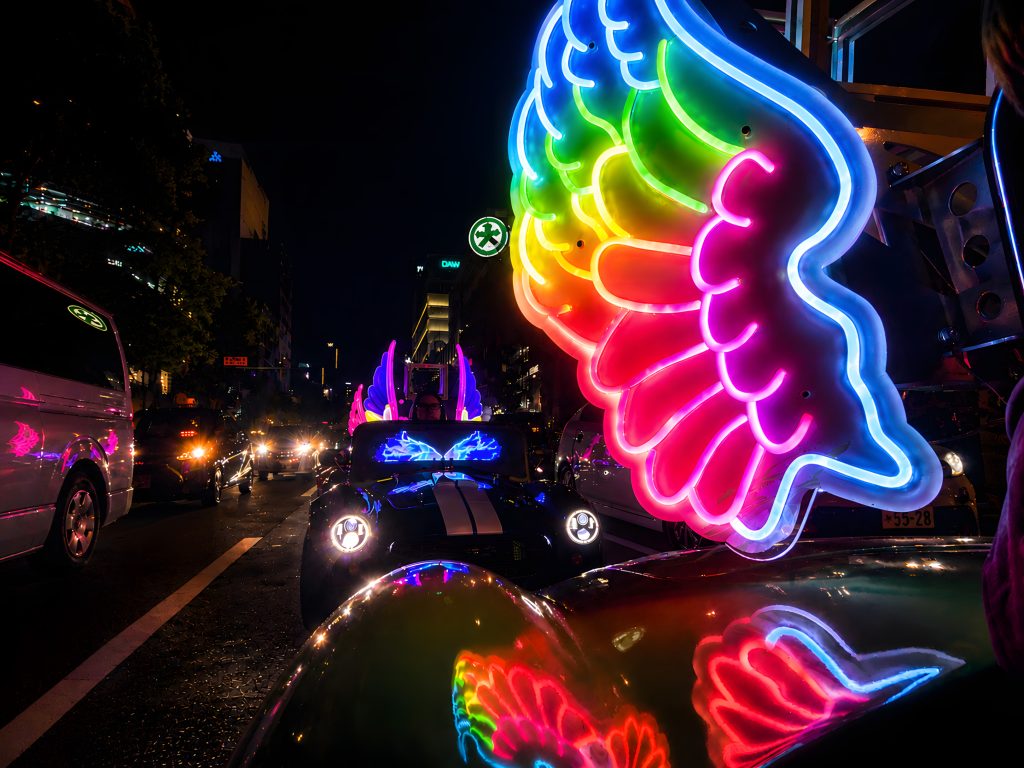
Time changes the Osaka go karting experience and its package
W Go-Kart Osaka divides starts into morning/afternoon, evening and night. Light conditions evolve across those bands, and the package price changes with them. A buyer should therefore combine the desired view with the correct level of included extras rather than selecting the cheapest or latest hour in isolation.
10:00–16:00 aligns naturally with the Castle recommendation
Morning-and-afternoon tours start hourly from 10:00 through 16:00 at JPY 7,000. They include the approximately one-hour experience, insurance, guide and costume. Coffee is JPY 500, a speaker JPY 500 and a 360 camera JPY 1,000.
A visitor focused on the road view can keep this package simple. Daylight supports visual detail, and the optional camera remains a choice rather than the centre of the purchase. Seasonal sun position and weather vary, so no exact lighting angle should be promised for a given hour.
17:00–19:00 offers transition light without the full night bundle
Evening starts at 17:00, 18:00 and 19:00 cost JPY 10,000. The same three extras remain individually priced. This band can suit a traveller who wants the city changing from day towards night but does not need the latest schedule or automatic bundle.
The visual result depends on date and weather. A 17:00 summer departure and the same hour in another season will not present identical darkness. Select the band for its broader transition character, not a guaranteed sunset moment.
20:00–22:00 makes the electric night identity most explicit
The Night Experience starts at 20:00, 21:00 and 22:00 at JPY 13,000. Coffee, speaker and 360 camera are included with the core service. It fits a visitor who wants the city lights to dominate and expects to use the extras rather than simply tolerating a late return.
The three late starts publish the same current package, but they can occupy the trip differently. A 20:00 departure leaves more time after the guided return; 22:00 places the service at the end of the night and makes onward transport more important. Live availability and the exact travel date should decide between them. The website does not guarantee a last train, hotel transfer or fixed post-tour finish time.
The camera does not permit handheld photography while moving, the speaker remains secondary to guide signals, and coffee belongs around safe service handling. The inclusions comparison explains those practical boundaries, and the electric night guide covers the visible design without inventing technical specifications.
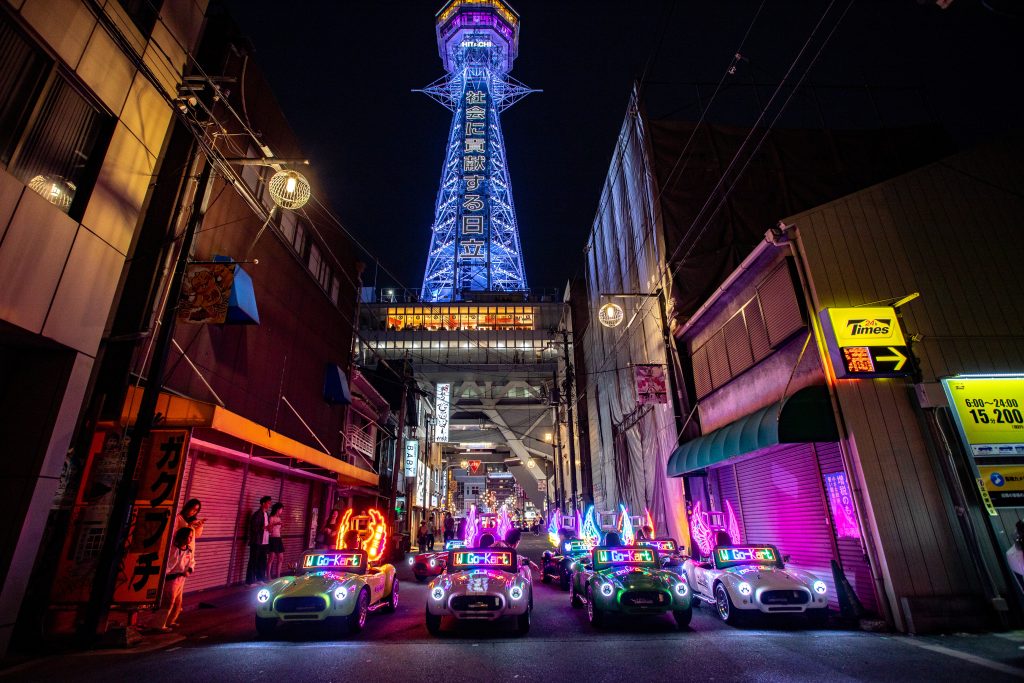
The view is experienced from public roads, not a private photo set
Both routes share ordinary traffic with other road users. A signal can divide the group, congestion can change the timing and the guide may make decisions based on live conditions. The mapped 48- and 46-minute figures are not lap targets or guarantees that every landmark remains visible for a fixed interval.
Guide leadership creates the route but not a staged city
The guide leads the group and supports route movement; each visitor controls a kart and follows traffic law. Osaka Prefectural Police provides visitor driving rules for the wider road environment. A colourful kart does not grant priority over signals, pedestrians or ordinary vehicles.
A customer should not ask the guide to stop illegally, repeat a block or separate from the group to improve an image. The street-tour perspective is memorable precisely because it is real, but that reality comes with traffic and safety limits.
Photography is planned around stops and guide assistance
W Go-Kart Osaka prohibits taking photos while driving. Use suitable stops and guide support instead. A couple can decide in advance whether the included night camera matters, but neither person should pressure the driver in front to pose or handle a phone in motion.
The website does not publish a guaranteed number of stops, photo files, camera model, delivery method or exact landmark background. Treat any approved media as part of the experience rather than a contractual photo shoot.
Light rain changes the surface appearance but not the safety owner
Light rain may allow operation and rain gear may be provided. Severe or unsafe weather can cause the operator to cancel or reschedule. Wet reflections might alter the city mood, but no one should book because rain is expected to improve images. W Go-Kart Osaka decides whether the route can safely operate.
Valid documents come before either route mood
The Castle-versus-neon choice matters only after a visitor qualifies to drive. W Go-Kart Osaka accepts a valid Japanese licence; an original 1949 Geneva Convention IDP with original domestic licence and passport; or, for Switzerland, Germany, France, Belgium, Monaco and Taiwan, an accepted Japanese translation with original licence and passport.
Every driver in a shared memory needs an individual document set
One partner’s complete documents cannot qualify the other. A digital permit, photocopy or informal translation is insufficient. The National Police Agency’s IDP guidance confirms the convention and original-form requirements. Resolve legal questions before paying for a route that one traveller cannot drive.
The document check also changes the arrival plan. Both loops leave from 3 Chome-5-2 Shinmachi, and the operator asks guests to arrive ten minutes before departure. Nishiohashi is the closest published rail approach at roughly three to five minutes on foot; Nishi-Nagahori is about eight to ten minutes away, and Shinsaibashi about ten. A group should not treat the member carrying everyone’s paperwork as the only person who needs to be early. Each driver should reach the base with the original documents in hand, leaving enough time for staff to check the individual set before the briefing.
Closed-toe shoes matter more than a chosen costume
Comfortable clothes and closed-toe shoes are required; sandals and high heels are unsuitable. A costume is included in every band, but the website does not promise a design or size. Choose what staff can provide safely and keep loose elements away from the controls.
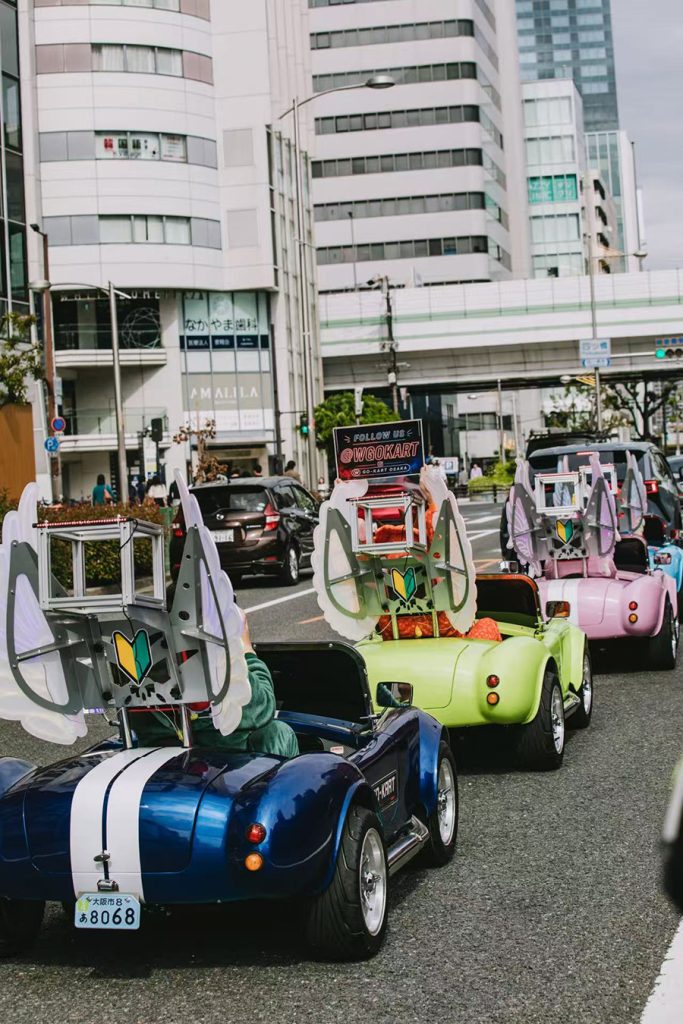
Choose the Osaka go karting experience by what comes next
The loop returns to Shinmachi, so the next itinerary segment can settle a close decision. A daytime Castle tour can lead into evening food or shopping. A night city loop can become the final major activity before returning to a hotel. The latest start still requires an onward transport plan from Shinmachi.
For a 22:00 choice, plan the return from the base before committing to a late restaurant, train or hotel connection. The published service is a guided loop, not a hotel-transfer package, and traffic can affect real-world movement. A traveller staying around Namba should still calculate the journey from Shinmachi rather than assuming the city route finishes beside Dotonbori. Someone with an early departure the next morning may get a better experience from 20:00, even though the later hour sounds more dramatic, because it leaves more margin after the group returns.
Customer cancellation is free up to 48 hours before departure. Inside 48 hours it is non-refundable, and rescheduling depends on availability. If the operator cancels for unsafe weather, the current policy offers a refund or no-cost reschedule. Review the commercial terms before linking the tour to another fixed booking.
Service details checked on 24 August 2026: routes, mapped distance/time, recommendations, start bands, prices, inclusions, address, documents, clothing, photo, weather and cancellation terms were checked against W Go-Kart Osaka’s current material. Castle, Dotonbori and Tsutenkaku context uses Osaka’s official tourism guide. No admission, photo stop or fixed lighting is promised.
Choose the Castle loop when daylight, a historic anchor and contrast with a Minami evening matter most. Choose the city loop when illuminated karts, connected southern districts and an after-dark package are the reason for driving. W Go-Kart Osaka supplies the same service foundation to both—a staffed base, briefing, guide, insurance, electric kart and return—while the chosen scenery gives the hour its own character.