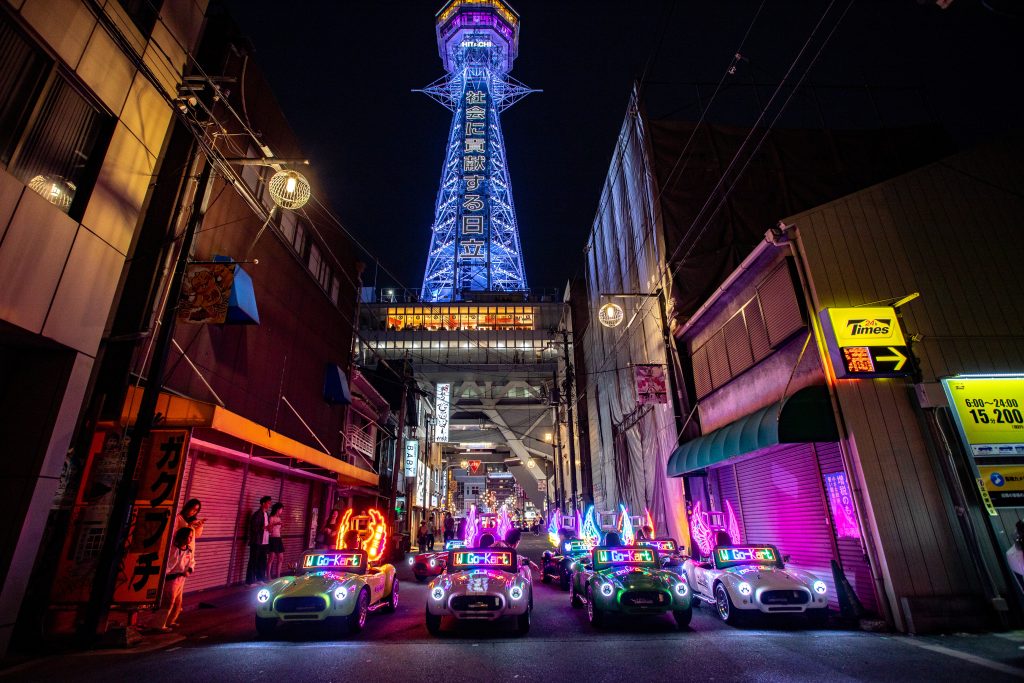
The Osaka neon go kart tour from W Go-Kart Osaka is its Tsutenkaku city loop, an approximately 8.9-kilometre, 46-mapped-minute route recommended at night. It begins and returns to Shinmachi and passes through or near Amerikamura, Shinsaibashi, Dotonbori, Namba/Nipponbashi, Ebisucho, and Shinsekai/Tsutenkaku under guide leadership.
Its strength is not one guaranteed neon sign. It is the change from creative streets and shopping context to entertainment districts, transport-centred Namba, specialist Nipponbashi, and the retro tower identity of Shinsekai. The visitor experiences those contrasts from a moving driver’s position. Exact roads, illumination, views, stops, and time in each district are not published.
The Osaka neon go kart tour follows a three-act city arc
The route map can be understood as three broad acts without converting its labels into a turn-by-turn itinerary. The first establishes the Shinmachi and Amerikamura/Shinsaibashi context. The second moves through the dense Dotonbori and Namba/Nipponbashi visitor zone. The third gives the southern route its Tsutenkaku identity before returning to the same service base.
Act one leaves Shinmachi for Amerikamura and Shinsaibashi context
Reception happens at 3 Chome-5-2 Shinmachi, Nishi Ward. That address matters because it is neither Namba nor Tsutenkaku. Guests arrive ten minutes early, present the accepted originals, receive the briefing, and then follow the guide. The initial change from a fixed base into the wider city is part of the experience, although no exact first road is stated.
Act two concentrates Dotonbori, Namba, and Nipponbashi identities
Official Osaka tourism describes Dotonbori as a symbolic Minami shopping and entertainment district known for large three-dimensional signs. W Go-Kart Osaka’s map places that name alongside Namba/Nipponbashi. This supports a dense urban subject, not a promise to stop at a billboard, walk the river, visit a shop, or spend an equal number of minutes in each area.
Act three gives the route its Shinsekai and Tsutenkaku anchor
Official tourism identifies Tsutenkaku as an Osaka landmark and includes it among evening and night-view subjects. The operator’s real photograph shows several electric karts near the illuminated tower area. Together, those sources explain the route’s night identity. They do not guarantee admission, a specific approach angle, or the same image for every departure.
Six map names require six careful reading habits
A map label answers the broad question “what urban context belongs to this loop?” It does not automatically answer “which road,” “how close,” “for how long,” or “where can we stop?” W Go-Kart Osaka describes the route as passing through or near the named areas. Preserving both verbs is more accurate than rewriting every label as a guaranteed drive through its busiest centre.
Through and near are not interchangeable route promises
A guest may experience one district directly and understand another from adjacent context. The current map is a buyer orientation, while the guide handles the operational route. Exact proximity is not stated, so no distance from the kart to a sign, tower, canal, or station should be invented.
Named does not mean equally long
Approximately 46 mapped minutes cannot be divided evenly among six labels. Traffic movement and the physical spacing of the areas make that calculation meaningless. One place may feel like a transition and another like the visual anchor. The operator publishes no minute allocation by district.
Recognizable does not mean narrated
Official visitor sources help establish why Dotonbori and Tsutenkaku are recognizable subjects. W Go-Kart Osaka does not publish a commentary script or guarantee that each label is announced. A traveller can review a city map beforehand, then keep their eyes and attention on the road when the group is moving.
The route works after dark because districts change, not because lights are fixed
Night makes signs, headlights, storefronts, and the tower part of the moving visual field. Yet light levels depend on time, weather, businesses, traffic, and the direction of travel. The website publishes a recommendation, not a minimum brightness standard. A responsible plan values urban contrast even if one sign is dim or one view is blocked.
Amerikamura and Shinsaibashi establish a contemporary opening
These names tell the buyer that the city loop is not solely a Tsutenkaku shuttle. A traveller who spent the afternoon shopping around Shinsaibashi may recognize the area’s identity from a new road-level position. Recognition can deepen the drive without requiring a repeat walking stop.
Dotonbori and Namba increase visual density in the middle
A diner may already associate Dotonbori with large signs and busy streets. From a kart, those elements become part of a brief moving sequence rather than a destination to inspect. The driver should not turn their head to search for one famous image or slow the group to recreate a photograph. Guide position and current traffic remain primary.
Tsutenkaku supplies a clear southern identity without ending the route
The tower is visually distinctive enough to name the option, but the service does not finish there. Both published loops return to Shinmachi. A guest who wants a long Shinsekai dinner, tower admission, or a slow walk under the signs should schedule that separately. The go-kart experience supplies connection and motion; the walking visit supplies depth.
One landmark photograph should not become the whole purchase promise
The authentic Tsutenkaku image is valuable precisely because it is real operator evidence. It shows karts, a night setting, and a recognizable tower context. It does not disclose the departure time, traffic state, route variation, weather, camera settings, or number of stopped moments. A future guest should expect the service category, not a duplicate frame.
A tower-first planner should visit the attraction before check-in
If observation-deck entry is essential, consult the current attraction’s own hours and ticket conditions and complete that visit independently. Do not assume the route pauses for admission. Afterward, travel to Shinmachi with a proper buffer. The operator’s Ebisucho and Shinsekai map labels do not turn the kart into collection transport from the tower.
A photograph-first visitor should separate portrait time from road time
W Go-Kart Osaka tells guests not to take photographs while driving. The site says stopped photo opportunities exist and guides may help, but it does not publish their location or number. A visitor can take a careful stationary portrait at the base and treat any route image as an additional moment rather than demanding a tower composition from moving traffic.
A repeat visitor can value the transitions instead of another attraction entry
Someone who has already walked Dotonbori and entered Tsutenkaku may not need more depth at either site. The useful difference is seeing how several known districts relate across one guided loop. That makes the route suitable for a repeat visitor without inventing new roads or exclusive access.

Before, during, and after need different kinds of Osaka detail
Before the drive, choose one district for depth
A nightlife diner could spend unhurried time in Dotonbori, while a pop-culture visitor might choose Nipponbashi and a landmark traveller might enter Tsutenkaku. Completing one depth activity before the kart prevents frustration when the moving route cannot provide shopping, admission, or a meal. It also gives the place names personal meaning when they appear later.
During the drive, let the guide control the operational sequence
The guide leads the group at all times. The website does not publish a navigation handoff, self-guided deviation, commentary script, radio specification, guide-to-guest ratio, or exact signals. Listen to the current briefing and respond to the current road instead of trying to identify every map label at the moment it appears.
After the drive, return to the district that deserves slower attention
Because the service returns to Shinmachi, the party can decide which area earned a second visit. This is especially useful for a first-time visitor who does not yet know whether they prefer Shinsaibashi shopping, Dotonbori food, Namba access, Nipponbashi specialist culture, or Shinsekai atmosphere. The route can inform a later walking choice without becoming transport to it.
The 17:00–22:00 starts change the night’s shape
Starts at 17:00, 18:00, and 19:00 cost JPY 10,000 per person. Starts at 20:00, 21:00, and 22:00 cost JPY 13,000. All include approximately one hour, guide, insurance, and costume. Before 20:00, coffee is JPY 500, a speaker JPY 500, and a 360 camera JPY 1,000; the Night Experience includes all three.
An earlier start can leave a full dinner after the Shinmachi return
A 17:00 or 18:00 plan can make the route the opening of the evening. Do not book a restaurant at start time plus 46 minutes: the map value is not the full service release. Leave space for reception, briefing, approximately one hour, traffic variation, return handling, and travel from the base.
A later start can follow a slow Minami visit
A 20:00–22:00 departure allows more daytime and early-evening depth before the drive. It also requires stronger onward-transport planning, especially for the final start. The operator does not provide a hotel drop-off, and the named southern districts are not finish points.
Sunset cannot be inferred from the word night
Season and weather change natural light. The 17:00 band can look different across the year, and the 20:00 band can look different across weather conditions. Check a current official forecast and warning source, then use the operator’s time-band recommendation without treating it as a light warranty.
Legal and practical preparation keeps the neon secondary
Every participant drives and needs an accepted original document set. That may be a Japanese licence; an original 1949 Geneva Convention international driving permit with original domestic licence and passport; or, for the listed eligible jurisdictions, an accepted Japanese translation with the original licence and passport. Phone images and photocopies do not replace originals.
Closed-toe shoes matter more than matching a night photograph
The operator asks for comfortable clothing and closed-toe footwear. Costume is included, but it does not replace practical dress. A guest should prepare for the forecast and road-level environment, then treat visual styling as an optional layer.
The no-phone rule protects the district experience
Do not use a phone while driving. Trying to capture every bright sign would pull attention away from the guide, signals, pedestrians, and surrounding vehicles. The 360-camera option or inclusion can support recall within current instructions, while stopped photo moments keep hand-held photography separate from motion.
Weather terms outrank the desired visual condition
If the operator cancels because conditions are unsafe, current terms provide a refund or no-cost reschedule. Customer cancellation is free until 48 hours before departure; inside the boundary it is non-refundable, and requested rescheduling depends on availability. A neon preference does not override an operational decision.
Use an Osaka neon go kart tour to connect, then explore slowly
The Namba city-route guide explains Namba’s place inside the larger loop. The drive-first nightlife plan helps separate dinner and walking depth from the road hour. Compare the six starts in the night timing guide.
Once every driver has the correct originals, use the booking form for the date, time, guest count, and route tier. Read the commercial disclosure before payment. The booking should survive an ordinary change in traffic, weather, or one missing photograph because its value rests on the whole district sequence.
Route information checked on 24 August 2026: map labels, approximate distance/time, night recommendation, start/return, starts, prices, inclusions, photo rule, documents, clothing, and terms were checked on W Go-Kart Osaka pages. Official tourism supports only district and landmark identity. No road, light level, view, stop, attraction entry, photo output, exact finish, or sunset is promised.
The Tsutenkaku route works after dark because it joins several different Osaka identities in one moving arc. Give one district slow attention before the drive, follow the guide through the live sequence, and return later to whichever area deserves depth. That balance makes the lights meaningful without asking them to perform like a controlled stage.