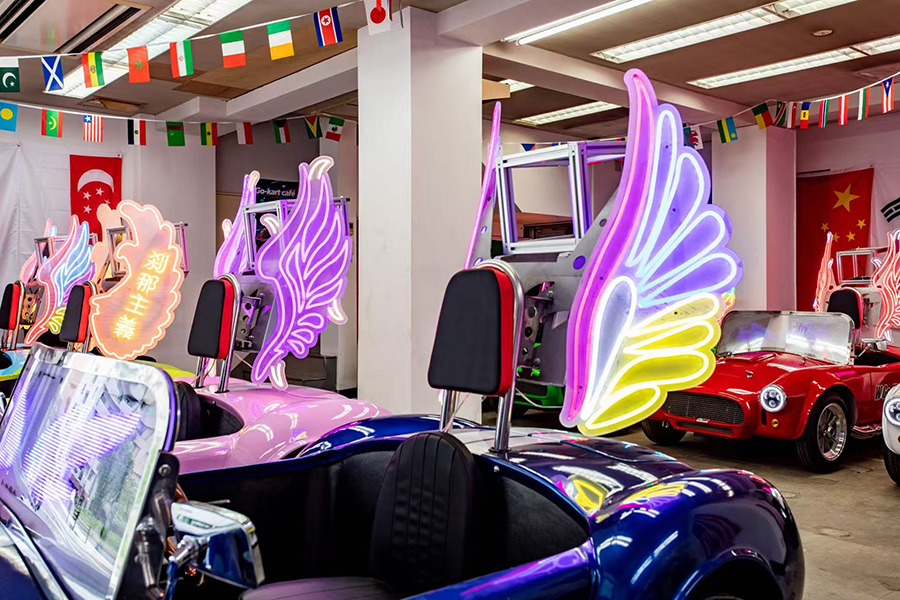
The confirmed Osaka go kart safety rules at W Go-Kart Osaka start before the road. Each driver brings an accepted set of original documents, wears comfortable clothing and closed-toe shoes, arrives ten minutes early at the Shinmachi base, listens to the briefing, follows the guide, and does not take photographs while driving.
The operator publishes stopped photo opportunities and says guides may help. It also may cancel when weather makes conditions unsafe, with the current refund or no-cost reschedule remedies. These facts create clear safety boundaries. The website does not publish a speed, control layout, helmet rule, formation gap, hand signal, radio specification, guide ratio, or exact stop procedure, so current staff instruction must outrank assumptions.
Osaka go kart safety rules begin in the hotel room
Legal originals determine who can enter the driver’s role
A valid Japanese licence is one accepted path. The foreign-visitor paths use either the original 1949 Geneva Convention permit with original domestic licence and passport, or an accepted Japanese translation with original licence and passport for the listed jurisdictions. Copies and phone images do not replace the physical set.
Closed-toe shoes belong on the driver before departure
Do not travel to reception in sandals and expect a shoe-loan service; none is published. Wear or carry the right pair before leaving the hotel. Comfortable clothing should suit the actual forecast and road-level environment. Costume is included but remains a visual layer over practical dress.
Alcohol should not be part of the pre-drive itinerary
General JAF and police guidance states that driving under the influence is prohibited. W Go-Kart Osaka uses public roads. A nightlife itinerary should place drinking after all driving responsibilities have ended, not assume a guided group or included insurance changes the rule.
The phone should already have a storage plan
The operator says not to photograph while driving, and Osaka Police warns against holding or watching a mobile phone during driving. Decide where the phone will remain before the briefing. Do not make a driver solve storage or camera settings after movement begins.
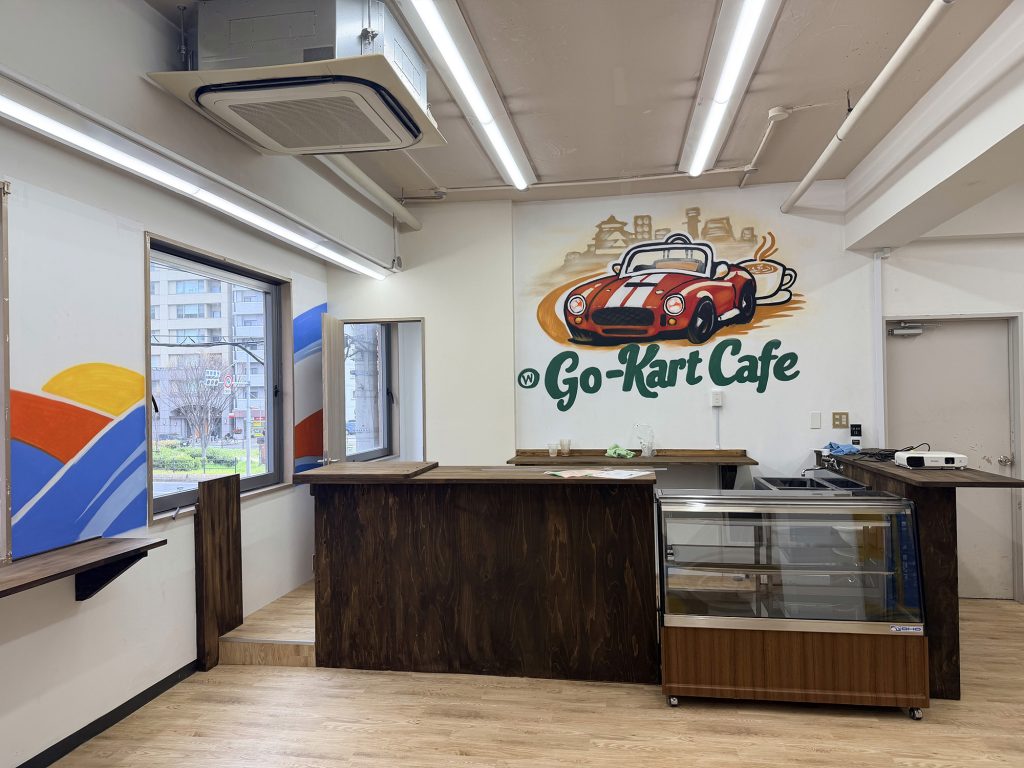
Reception is the boundary between trip planning and operator instruction
Ten minutes early starts after the party reaches the desk
The base is 3 Chome-5-2 Shinmachi. Station navigation, taxi traffic, luggage, and group reunion need separate time. The operator estimates three to five minutes from Nishiohashi, eight to ten from Nishi-Nagahori, and about ten from Shinsaibashi. No late-arrival grace is published.
Every driver presents their own evidence
A coordinator or local friend cannot lend eligibility. The booking form’s one-to-seven guest range does not validate documents, guarantee capacity, or create a passenger role. The real roster consists of the people who arrive with accepted originals and intend to drive independently.
Uncertainty should be stated while everyone is stationary
W Go-Kart Osaka supports beginners and says no prior kart experience is required. A first-time driver should say what they do not understand before the briefing ends. The public pages do not disclose controls or signals, so another operator’s video is not a safe substitute for current instruction.
Insurance inclusion should not change behaviour
Insurance is included in every package, but no policy limits, exclusions, deductibles, insurer, or claim process are published on the pages reviewed. Inclusion is not permission to ignore the guide, use a phone, or pursue a photograph. Safety choices remain the same.
The stationary kart is the last place to resolve control questions
Confirm the actual controls without importing specifications
This article does not state pedal arrangement, braking response, steering effort, starting sequence, or switch locations because the website does not publish them. Identify the real kart and follow staff direction while stationary. Do not infer from a rental kart, scooter, game, or competitor model.
Confirm what current guide direction looks and sounds like
The site does not publish hand signals, radios, language coverage, or a formation diagram. Listen to the live explanation and ask for clarification before movement. The goal is not to memorize an outside list but to recognize the current operator’s instruction.
Make costume and camera adjustments before movement
Costume is included, the 360 camera is an option before 20:00 and included at night, and the speaker follows the same commercial pattern. The website does not publish mounting or operating methods. Any setup must follow current staff direction and be finished before the road demands attention.
A driver who remains unwilling should not expect passenger conversion
Legal eligibility and briefing do not force participation. The site publishes no passenger seat, spectator ride, or driver-to-rider conversion. Resolve genuine unwillingness before movement rather than placing the guide and group in an improvised situation.
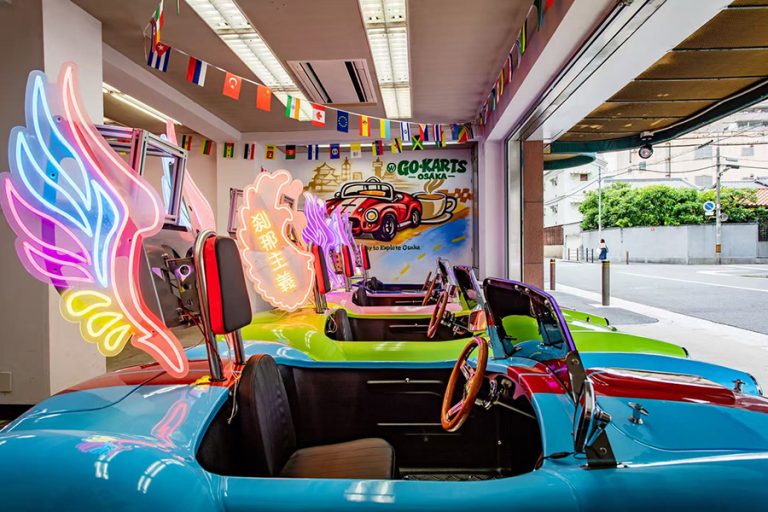
Moving on public roads changes the attention hierarchy
The guide is first for route direction, not the only road object
The guide leads the group at all times, which reduces navigation work. Drivers still observe current signals, pedestrians, and surrounding vehicles. JAF guidance emphasizes keeping left, yielding to pedestrians, avoiding alcohol, and avoiding mobile-phone distraction. Current law, signs, and operator instruction remain authoritative.
Landmark recognition comes after road awareness
The Castle loop and Tsutenkaku city loop contain strong visitor subjects, but no view is worth turning away from a live road decision. A driver may miss a sign, tower angle, or district boundary. The route remains valid without every participant seeing every label at the same moment.
Friends should not invent a photo formation
Authentic operator images show several karts together. They do not publish an allowed gap, side-by-side procedure, posing signal, or traffic arrangement. Follow the guide rather than moving closer, slowing independently, or looking sideways to recreate a reference photograph.
No published speed means no performance target
W Go-Kart Osaka does not publish maximum speed, average speed, lap time, route record, or racing objective. The approximate map distances and minutes should not be divided into a target pace. Public-road rhythm changes with traffic and operator direction.
Group confidence should be settled without peer pressure
A booking may contain friends with very different road experience. One confident driver should not answer a nervous driver’s control questions, hurry their preparation, or promise that the road will feel easy. The guide and current staff are the right people to explain the actual service. If one participant still cannot understand the instruction or does not feel ready, the group should allow that concern to be resolved before departure.
One-to-seven guests describes the form, not a road formation
The reservation form accepts a guest count from one to seven, but that field does not publish available fleet size, guide ratio, departure capacity, or how karts will be arranged. A party should submit its real driver count and wait for the booking response. On the day, participants should take only the positions and sequence assigned by the operator, even when friends hoped to drive beside one another for photographs.
Stopped photo moments have a different safety boundary
Stopped means current permission, not personal assumption
The operator says stopped photo opportunities exist and guides may assist. The site does not publish their locations, number, or duration. A driver should not decide that a red light, congestion, or personal pause automatically becomes a photo session.
Put the phone away before movement resumes
A stopped moment can end quickly under guide direction and live traffic. Finish the current action and return attention before moving. Osaka Police material explains that holding or watching a phone while driving draws attention from surrounding hazards.
The 360 camera does not authorize screen checking
No mounting, control, resolution, recording, transfer, or editing method is published. Use the option only as currently instructed. The desire to confirm a recording should not compete with guide direction or cause a driver to handle a device while moving.
A photograph cannot be guaranteed by safety planning
Weather, traffic, light, group arrangement, and stop operation vary. The authentic Tsutenkaku-area image confirms a real service setting, not a future result. A required landmark portrait belongs in a separate stationary visit where the traveller controls time.
Weather can move the decision outside the driver’s control
Use official forecast and warnings as preparation inputs
The Japan Meteorological Agency publishes Osaka forecasts and warnings. Those sources can guide clothing and travel awareness. They do not decide whether W Go-Kart Osaka runs a particular departure and do not submit a cancellation on the visitor’s behalf.
The operator decides when road conditions are unsafe
If the operator cancels for unsafe weather, the current terms provide a refund or no-cost reschedule. A customer preference for perfect light or dryness is different. Customer cancellation is free until 48 hours before departure and non-refundable inside that boundary.
Rain planning should not invent equipment
The website does not publish rainwear supply, waterproof storage, tyre specification, wind threshold, heat threshold, or a weather cancellation formula. Prepare personal clothing sensibly, check current information, and follow operator communication rather than supplying missing numbers.
A route photograph is not a weather forecast
Images show conditions when they were taken. They cannot predict temperature, surface, wind, visibility, or traffic for the booking date. A guest should never use one clear night image to dismiss a current warning or operator decision.
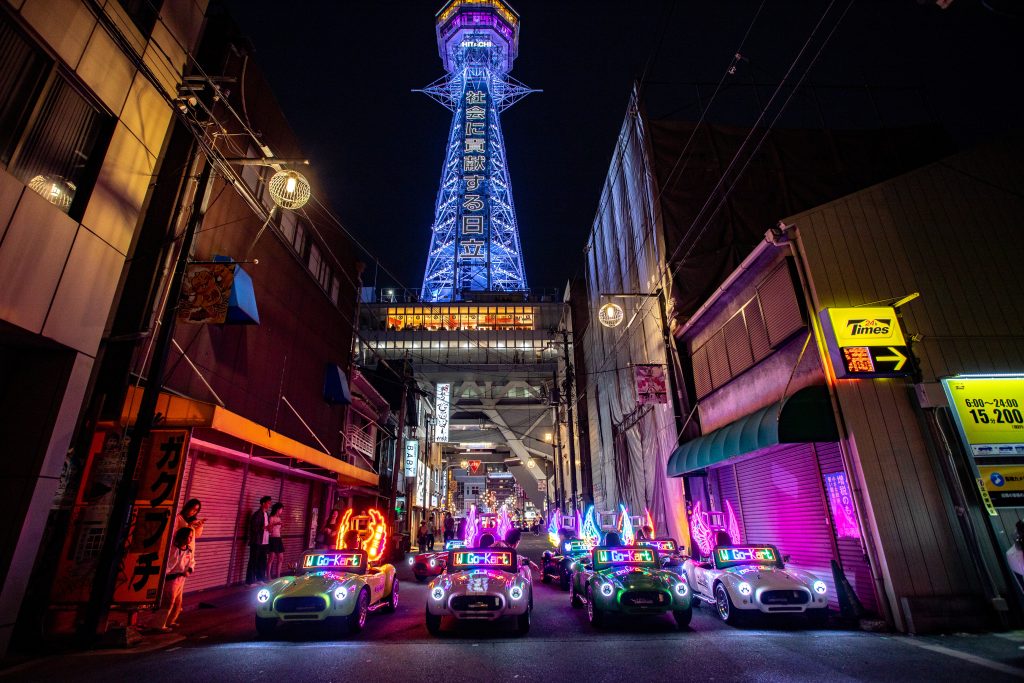
Return to Shinmachi before changing roles
The route is not finished at Namba, Castle, or Tsutenkaku
Both loops return to the same base. Do not branch toward a hotel, attraction, or restaurant because a landmark appears nearby. The guide-led service closes at Shinmachi; onward transport begins afterward.
Resume phone use only after the operator indicates the drive is complete
Being near the storefront is not the same as finishing current operation. Follow the return procedure communicated by staff. The site does not publish a precise engine-off, parking, or dismount sequence, so this article will not create one.
Review images without turning them into future promises
A group can enjoy its stopped photographs or camera record after the drive. Do not claim that another start, route, guest, or weather condition will produce the same result. First-party experience evidence becomes misleading when separated from its limits.
Carry the original documents onward
The passport, domestic licence, permit, or translation may remain important for later Japan travel. The operator does not publish document custody or luggage storage. Each driver remains responsible for their originals after the service.
Keep the Osaka go kart safety rules attached to the correct zone
Use the public-road service guide for the product boundary, the licence guide for legal preparation, and the night start guide for a workable late itinerary.
Only then use the booking form and read the commercial disclosure. A safe plan does not need invented specifications. It needs the right originals at the hotel, practical clothing at reception, understood direction while stationary, undivided attention while moving, and respect for the operator’s weather decision.
Safety information checked on 24 August 2026: public-road format, guide/briefing, beginner support, documents, clothing, arrival, photo rule, stopped moments, routes, prices, insurance inclusion, weather remedies, and return were checked on W Go-Kart Osaka pages. Osaka Police/JAF/JMA support only general road and weather context. No speed, controls, helmet rule, formation, signal, radio, guide ratio, stop method, insurance limit, rain equipment, weather threshold, or return procedure is claimed.
The most reliable rule changes with the physical zone. Prepare in the hotel, disclose uncertainty at reception, learn the real kart while stationary, watch the road while moving, use a phone only at an authorized stop, and accept current weather direction. That sequence lets the operator’s real briefing stay in control of the experience.