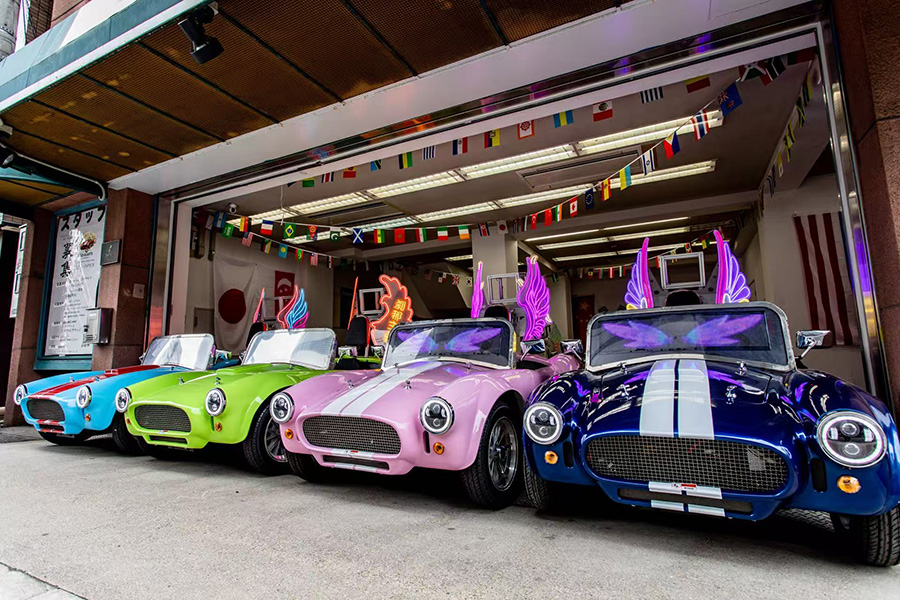
On a street go kart tour Osaka group, the guide creates coherence rather than a promise that every kart stays bumper-to-bumper. W Go-Kart Osaka says a guide leads the group at all times and provides a safety briefing before departure. Everyone follows one mapped loop from the Shinmachi base and returns there. Yet each driver must still obey a red light, yield to pedestrians and control their own electric kart.
That distinction is the best way to evaluate the service. The guide supplies route leadership, preparation and support; the road may temporarily change spacing. A beginner who welcomes that structure is a strong fit. A driver who expects to ignore signals to preserve formation, improvise a detour or hand responsibility to the guide is not.
A street go kart tour Osaka group is built before departure
Group cohesion begins at the reception desk, not at the first junction. The operator asks guests to reach 3 Chome-5-2 Shinmachi ten minutes before the selected start. That shared arrival creates time for original-document checks, clothing readiness and the guide’s briefing. When these inputs are settled together, the group can leave with one route and one operating frame.
The document check creates a group of eligible drivers
Each participant must qualify independently through a valid Japanese licence, an original 1949 Geneva Convention IDP set, or the accepted foreign-licence and authorized Japanese-translation route for listed jurisdictions. One friend’s documents cannot cover another person. The website does not publish a passenger seat, so the guide cannot solve ineligibility by pairing two guests in one kart.
The safety briefing gives beginners a common starting language
The homepage says no prior go-kart experience is required and guides support beginners through the tour. This does not mean every visitor arrives with the same road background. The briefing is where the group can align around the actual kart, guide direction and route sequence before traffic adds pressure. The one-hour service walkthrough places this stage correctly inside the experience.
Closed-toe shoes and secured clothing reduce preventable interruptions
W Go-Kart Osaka requires closed-toe shoes and advises comfortable clothing without loose items that may fall. This preparation supports the whole group because a personal wardrobe issue can delay or distract one driver. Costume is included, but its appearance should remain secondary to secure clothing and unobstructed controls.
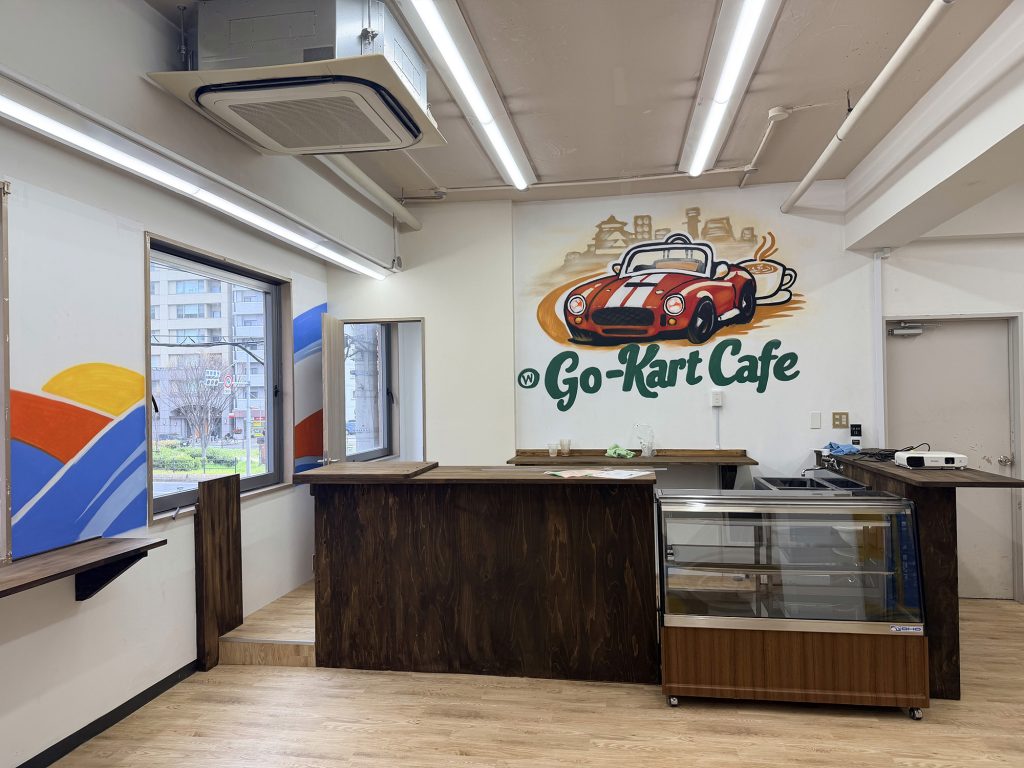
The guide leads one route without replacing every driver
“Guided” describes a service relationship: the operator supplies the route leader and the guests follow. It does not describe remote vehicle control. Drivers remain responsible for the road immediately around them. The strongest group is therefore not the tightest visual line; it is the set of people making compatible lawful decisions while following the same guide.
A route leader removes the need for personal navigation
The Castle loop and Tsutenkaku city loop are already mapped. Guests are not expected to invent a sequence through Osaka or use a phone map while driving. This allows attention to stay on the guide and surrounding traffic. The site does not publish a headset, radio system or turn-by-turn cue list, so none should be assumed before arrival.
A red signal can divide the line without dividing the tour
Osaka Police visitor guidance says a red light requires stopping. If the guide or an earlier kart passes before the change, a following driver still waits. The shared map and guide-led format define the group more reliably than continuous visual spacing. Racing through a change to “stay together” would reject the very public-road framework the service uses.
A crossing can reorder distance without changing the destination
Pedestrian priority can require one kart to stop while another has already moved. That is ordinary city operation. The participant should observe the crossing directly rather than stare only at the kart ahead. Both the Castle and city loops return to Shinmachi, giving the group a common destination beyond any temporary gap.
An experienced driver should not improvise a shortcut
Familiarity with Osaka or confidence in traffic does not turn the tour into a rental. A guest who believes they know a faster street should still follow the guide-led route. Personal navigation creates ambiguity for every kart behind and may move the driver outside the mapped service. Expertise is best expressed through calm compliance, not route invention.
Photo moments work only when driving attention has ended
The operator says taking photos while driving is not allowed. Its homepage also states that there will be stops where photos can be taken and that guides may assist with pictures. The careful reading is important: photography belongs to an approved stopped moment, while no particular landmark stop, number of stops, pose or final image is promised.
The guide’s photo help does not make a phone safe in motion
National Police Agency material warns that looking at or talking on a phone while driving prevents detection of danger. A guest should wait until the guide indicates an appropriate non-driving moment. A content creator who reaches for a device because another kart slows has not received permission to film.
The 360 camera follows the package and staff direction
Before 20:00, a 360 camera is listed as a JPY 1,000 option. At 20:00–22:00, it is included in the Night Experience alongside coffee and speaker. The website does not publish mounting details, files, resolution, delivery method or editing service. Use it only as staff currently arrange rather than importing expectations from another operator.
A promised-looking landmark is still subject to the real route
The Castle and Tsutenkaku labels help visitors choose a city view, but they do not guarantee a stationary composition. Signals, weather and public traffic remain active. A visitor whose main goal is a particular portrait should plan a separate walking visit, leaving the kart tour free to deliver its genuine moving perspective.
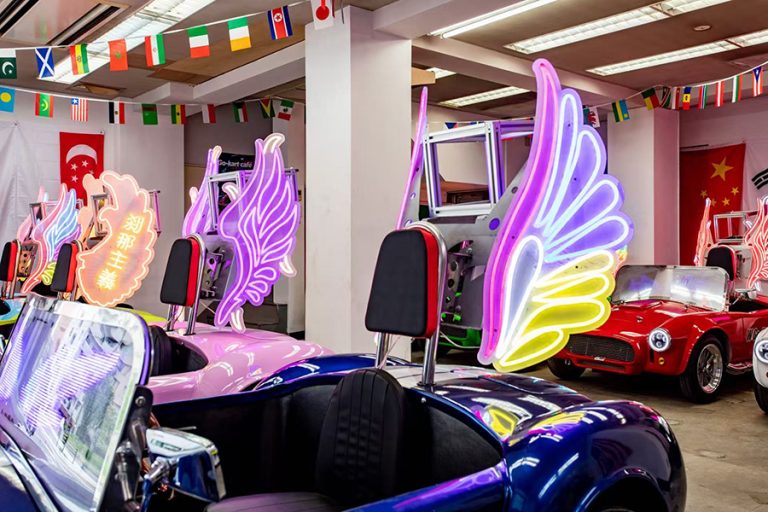
Two mapped loops give the guide a clear city assignment
The daytime-recommended Castle map shows approximately 12.6 kilometres and 48 minutes. The night-recommended Tsutenkaku city map shows approximately 8.9 kilometres and 46 minutes through or near Minami and Shinsekai districts. Both values sit inside an approximately one-hour service and neither is an exact finish guarantee.
The Castle assignment suits a daytime landmark group
This route works when the party agrees that a moving Castle-oriented perspective is the subject. It does not include museum admission or a park visit. If one guest wants historical depth, that person should schedule it separately rather than expect the guide to turn the public-road group into a walking tour.
The city assignment suits an after-dark street group
The city loop connects the context of Amerikamura, Shinsaibashi, Dotonbori, Namba/Nipponbashi, Ebisucho and Shinsekai. The guide-led sequence is valuable precisely because visitors do not need to navigate those areas independently while controlling a kart. It still returns to Shinmachi instead of leaving the party in Namba or below Tsutenkaku.
A group vote should settle the city view before the date
Ask every eligible driver to choose Castle/day or city/night, then look for a shared majority rather than mix expectations. The two-route comparison explains the visual difference. Once booked, everyone should be able to repeat the same route identity and Shinmachi return.
The guide is included across all three price bands
The published price is JPY 7,000 from 10:00 through 16:00, JPY 10,000 at 17:00–19:00, and JPY 13,000 for the Night Experience at 20:00–22:00. Approximately one hour, insurance, guide and costume are included throughout. Route leadership is therefore part of the core purchase, not a separately priced upgrade.
Price changes do not publish different guide ratios
The higher bands change timing and, at night, the accessory bundle. The site does not say that JPY 13,000 buys a private guide, smaller group or different staff-to-guest ratio. Buyers should not convert price into an unlisted service level. Live availability, not the one-to-seven form selector alone, determines what can be booked.
The group-size limit is real even though its number is not stated
The homepage says each tour has a limited number of participants to support safe, smooth operation and directs visitors to check availability. It does not publish a fixed fleet count or maximum per departure. A seven-person selection field shows a request option, not proof that seven spaces exist on every hour.
Weather decisions remain with the operator
Light rain may allow a tour and rain gear may be supplied. Severe or unsafe conditions can lead to cancellation, with refund or no-cost reschedule under current terms. A guide cannot preserve group movement against an operator decision that the road should not be used. Weather coherence means following the same communication, not voting separately.
Four participants reveal whether the guided format fits
A first-time kart driver benefits from the shared sequence
This guest has valid road-driving documents but no kart experience. They arrive early, ask about the controls, listen to the briefing and follow the guide without pretending to know the vehicle. The site’s beginner acceptance supports this fit, but it does not waive the driving-licence requirement.
A confident Osaka driver benefits only by accepting the route
Local street knowledge can reduce unfamiliarity but should not compete with guide leadership. This person is a good participant when they use experience to stay calm at signals and crossings. They are a poor fit if confidence becomes overtaking, shortcutting or instructing other guests independently.
A group organizer should coordinate facts instead of formation
The organizer’s useful work happens before departure: check each driver’s originals, share the address, select one route, preserve the arrival target and keep alcohol after the drive. The friends-planning scenario shows how different document and transport paths can still reach one briefing.
A creator should build the story around approved moments
This guest chooses the 360-camera arrangement if appropriate, follows staff instructions and waits for a published photo stop. They do not ask the guide to stage traffic or guarantee an image at one landmark. That restraint lets the group continue functioning as drivers rather than performers occupying a public road.
Verify what the street go kart tour Osaka site does not specify
W Go-Kart Osaka does not publish a guide language list, guide-to-driver ratio, radio equipment, exact hand signals, maximum group number, recovery procedure for a separated driver, number of photo stops or file-delivery method. These omissions should remain omissions. A responsible article cannot turn “guide leads the group” into operational details that have not been stated.
What can be verified is substantial: staffed Shinmachi check-in, safety briefing, guide leadership, beginner support, two maps, early arrival, physical documents, public-road rules, package bands, photo restrictions, limited availability and return to the same base. Use the live booking form only after those facts match the party.
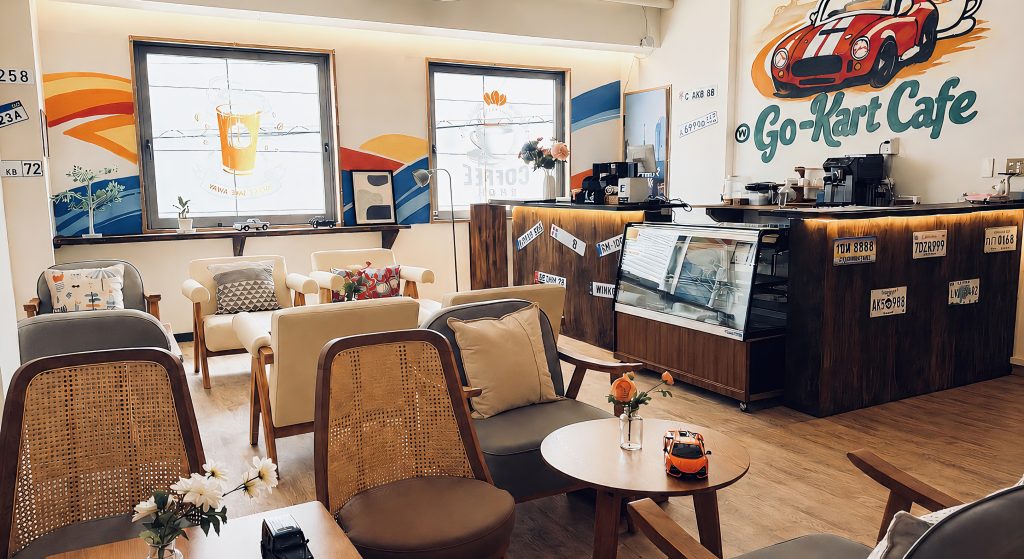
Guide and service information checked on 24 August 2026: briefing, guide leadership, beginner support, participant limit wording, photo guidance, route maps, arrival, prices, documents and policies were checked on W Go-Kart Osaka pages. Osaka Police and NPA material supports only ordinary traffic rules. No guide language, ratio, radio, signal system, fleet count, stop count, file delivery or separation protocol is claimed.
A guide-led group succeeds through shared direction and independent responsibility. W Go-Kart Osaka gives visitors a real route leader, a briefing, mapped city choices and a common return point. Guests make that service work by arriving as eligible drivers, letting red lights and pedestrians break the visual line when necessary, and rejoining the same route without chasing, filming or inventing their own way through Osaka.