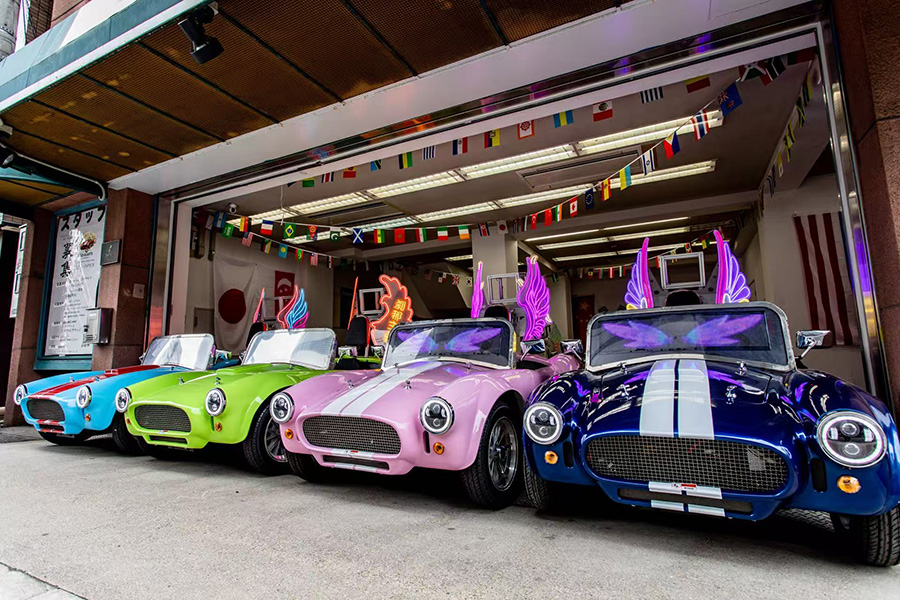
A go kart tour Osaka service is the better fit when a licensed visitor wants an electric public-road drive with a defined sightseeing loop, staffed check-in, safety briefing, guide leadership, insurance and return to the starting base. It is not the same purchase as taking a rental vehicle away to wander independently. W Go-Kart Osaka currently offers two guided loops from Shinmachi—Castle for daytime and the Tsutenkaku city route for night—within an approximately one-hour experience.
The service is strongest for a first-time visitor who values route structure and group support more than unrestricted navigation. The guide does not drive on the customer’s behalf or remove individual legal responsibility, but gives the departure a shared route and operating context. Start with the operator’s current service description, then use the reservation form only if a guided loop matches the experience expected.
A go kart tour Osaka booking buys route stewardship, not a loose vehicle
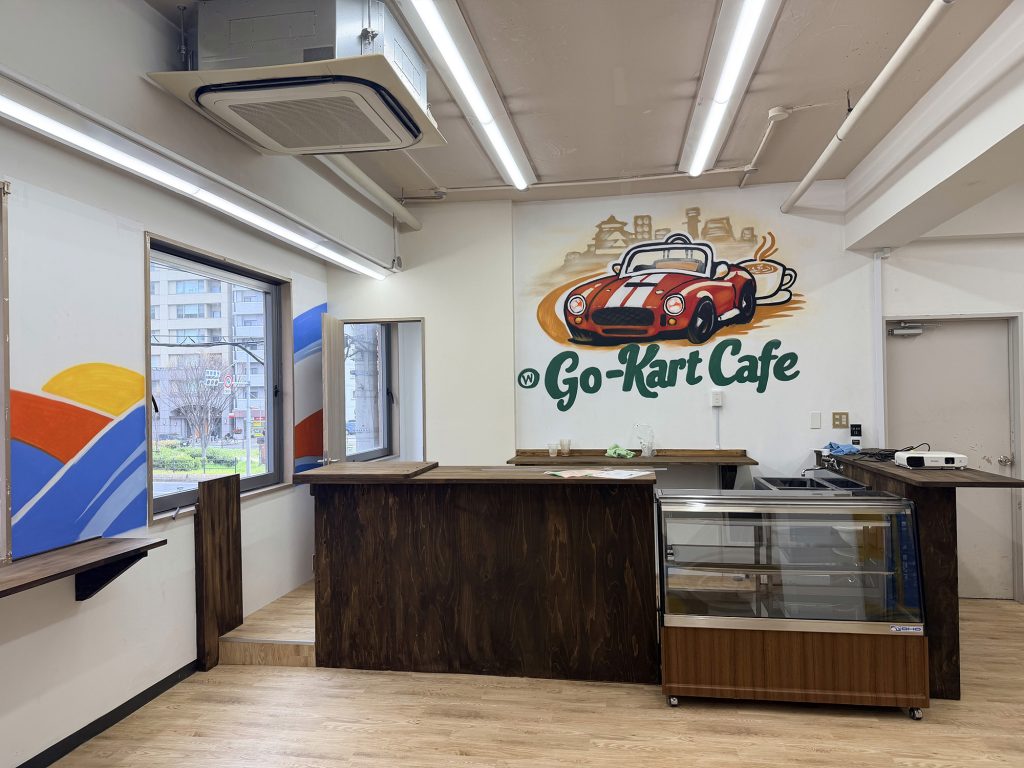
A free-roaming rental and a guided sightseeing loop solve different problems. Independent hire prioritises control over where and when to travel. W Go-Kart Osaka instead publishes a staffed return service with mapped sightseeing routes. The customer chooses the route and start, receives the briefing, drives behind the guide and returns to 3 Chome-5-2 Shinmachi.
The Shinmachi briefing gives the group one operating language
Before movement, the operator can check documents and explain how the group will follow the guide. This is especially valuable when visitors have different public-road experience or do not know Osaka’s street layout. The briefing does not create a private road, but it places the same service expectations in front of every driver.
A group of friends may arrive with different ideas about following distance, signals and photo opportunities. Resolving those ideas at the base is safer than improvising once the karts are in traffic. The service still requires each driver to listen, control the vehicle and comply with the law.
The two mapped loops replace a tourist’s improvised navigation task
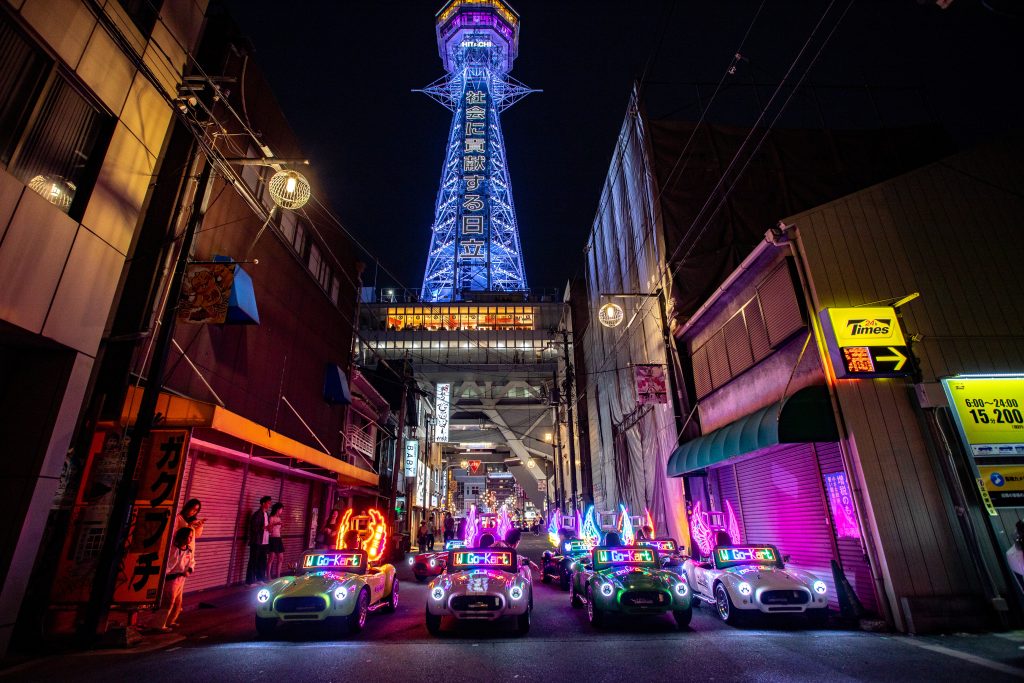
The Castle route material depicts approximately 12.6 kilometres and 48 minutes, with the historic area as its major visual anchor. The operator recommends it during the day. The Tsutenkaku city map depicts approximately 8.9 kilometres and 46 minutes through or near Amerikamura, Shinsaibashi, Dotonbori, Namba, Nipponbashi, Ebisucho and Shinsekai, and the operator recommends that loop at night.
These published routes allow a visitor to choose a type of Osaka scenery without designing a legal, coherent kart itinerary from an unfamiliar hotel room. They do not promise exact landmark stops, a fixed signal sequence or minute-perfect arrival. Live traffic and safety decisions still shape the drive.
Consider a first-time Osaka visitor who recognises Dotonbori and Tsutenkaku by name but cannot place Ebisucho, Shinmachi or the correct approach streets on a map. Independent route freedom would also transfer every navigation choice to that driver. The city loop removes that design burden while preserving the active experience of controlling the kart. The trade is equally clear: the visitor follows the published group route instead of diverting to a restaurant, hotel or unplanned landmark.
A separated traffic signal does not cancel the group structure
Public roads sometimes divide a group. A driver should not rush a changing light, block an intersection or abandon ordinary road rules to remain directly behind another kart. Guide leadership provides a route to re-form safely; it is not permission to force group cohesion at the expense of traffic law.
If the guide disappears temporarily beyond a signal, the safe response is not to invent a shortcut or copy an unrelated vehicle. Drivers should apply the briefing and the operator’s instructions for group movement while obeying the road in front of them. A friend farther ahead may be disappointed by the separation, but that does not justify a late turn or unsafe acceleration. The value of an organised route is that a temporary gap can be managed inside a shared service plan.
Osaka Prefectural Police publishes traffic rules for visitors and a road-safety video for foreign drivers. Those rules remain the wider operating standard. The guide supports the tour within them rather than replacing them.
A go kart tour Osaka group still gives each driver legal responsibility
The presence of a guide can make a route easier to follow, but it cannot make an unlicensed visitor eligible. W Go-Kart Osaka accepts a valid Japanese licence; an original 1949 Geneva Convention International Driving Permit with the original domestic licence and passport; or, for Switzerland, Germany, France, Belgium, Monaco and Taiwan, an accepted Japanese translation with the original licence and passport.
The guide cannot substitute for an original licence set
Every intended driver needs an individually complete path. A party leader’s documents do not cover companions, and a digital permit, scan or informal translation does not become valid because the activity is guided. Resolve the applicable route before paying and carry the physical originals to check-in.
The National Police Agency’s IDP guidance confirms that a digital permit is not valid and distinguishes the recognised convention. The tour document guide applies the operator’s three pathways without treating W Go-Kart Osaka as an issuing authority.
Guide signals sit beside traffic signals, never above them
A customer must observe lights, signs, pedestrians and other vehicles even while watching the guide. If a road signal conflicts with the desire to stay close, the traffic control wins. A driver should not copy another kart blindly or expect the guide to authorise an unsafe movement.
This distinction is one reason the product is sightseeing rather than passive transport. The visitor actively drives and remains responsible for behaviour. The operator provides a route framework and briefing around that responsibility.
Photography moves to safe moments outside the driving task
W Go-Kart Osaka prohibits taking photos while driving. A guided format can support images at appropriate stops or through guide assistance, but it does not turn a phone into safe driving equipment. The optional 360 camera in earlier time bands—or its inclusion in the Night Experience—does not change that rule.
The website does not promise a number of photo stops, camera specifications, file delivery method or a particular landmark background. A visitor choosing the service primarily for a staged shoot may therefore expect something the published tour does not offer.
The guided format changes what the current price includes
Price should be compared as a service bundle, not as a bare vehicle hour. Morning and afternoon departures run hourly from 10:00 through 16:00 at JPY 7,000. Evening starts at 17:00, 18:00 and 19:00 cost JPY 10,000. The Night Experience at 20:00, 21:00 and 22:00 costs JPY 13,000.
Guide, insurance and costume are present in every time band
Each current band includes the approximately one-hour experience, insurance, guide and costume. These inclusions are part of the operator’s defined tour format. They do not imply unlimited driving time, a custom route, a guaranteed costume design or permission to ignore safe clothing.
A buyer comparing prices should ask whether the alternative being considered includes the same service elements and return structure. “One hour” alone cannot show whether the product is a public-road tour, a track session or a vehicle rental. W Go-Kart Osaka is the first of those.
Insurance inclusion also belongs to that like-for-like comparison, but the site does not publish policy limits or invite the customer to interpret insurance as freedom from responsibility. The driver still needs valid documents and compliant behaviour. Likewise, a costume is an experience extra, not protective racing equipment. Evaluating each included item by its actual role keeps the guided package attractive for what it genuinely provides without assigning it benefits the operator has not stated.
The night bundle adds equipment without changing guide leadership
Coffee at JPY 500, a speaker at JPY 500 and a 360 camera at JPY 1,000 are optional in the morning/afternoon and evening bands. All three are included from 20:00 through 22:00. The current inclusions comparison helps a traveller evaluate the full package rather than treating JPY 13,000 as a simple surcharge for darkness.
The camera remains subject to safe use, the speaker remains secondary to instructions, and coffee does not belong in the driver’s hands while controlling the kart. Included extras do not change the underlying guided service or legal eligibility.
A mapped return has value for an itinerary with a fixed next step
Both tours start and return at Shinmachi. A traveller can plan the surrounding day around that known base rather than guessing where an open-ended rental will finish. Nishiohashi is the nearest published rail approach at roughly three to five minutes on foot; Nishi-Nagahori is about eight to ten minutes away, and Shinsaibashi about ten minutes away.
The return is not a hotel transfer. Traffic can affect live movement, and a 22:00 customer must still plan onward transport. Yet the same-base structure gives the itinerary a clearer endpoint than independent wandering would.
When a fixed Osaka loop is a better fit than independent wandering
A first-time visitor who wants to see a coherent part of the city from a low electric kart without navigating every turn independently is well matched to the service. A couple who wants the same route memory and a group that values a common briefing can also benefit. The Castle-versus-neon comparison helps those visitors choose the atmosphere.
Choose Castle daylight when one historic anchor should lead
Osaka’s official visitor guide describes Osaka Castle Park as a large central park with historic structures and seasonal landscapes. The guided Castle loop uses that broader area as its defining landmark and is recommended by the operator in daytime. It does not include park admission or a museum visit.
Choose the Tsutenkaku loop when connected night districts matter
The city route links a sequence of southern districts rather than a single historic anchor. Osaka’s official guide identifies Dotonbori as a major Minami entertainment district and Tsutenkaku as a Shinsekai landmark. The route can give them a shared night context without promising admission or a stop at either place.
An experienced local who wants to select every street, pause for an undefined period or keep the vehicle beyond a loop should not misread this service as solo rental. A traveller who cannot legally drive should not assume the guide turns the kart into a passenger activity. In both cases, the limitation is a sign of product mismatch rather than a reason to stretch the published offer.
The same test helps a family with a tightly scheduled afternoon. A known Shinmachi start and return can be useful when dinner or rail travel follows, provided the family leaves margin for real traffic and the roughly one-hour service. Someone whose priority is entering Osaka Castle Museum or spending an open-ended evening in Dotonbori should schedule those as separate visits. The kart route supplies a moving city perspective; it is not admission, door-to-door transport or a replacement for exploring on foot.
Service model checked on 24 August 2026: guided format, routes, mapped figures, start bands, prices, inclusions, documents, photography, address and return structure were checked against W Go-Kart Osaka’s current material. Road context comes from Osaka Prefectural Police and landmark context from Osaka’s official visitor guide. No solo rental, passenger ride, private road, custom route, photo deliverable or fixed traffic timing is claimed.
Choose the guided W Go-Kart Osaka format when the value lies in a prepared sightseeing loop, a staffed handoff, one briefing for the group and a defined return to Shinmachi. Choose another product type if unrestricted navigation or passive transport is essential. The guide makes Osaka easier to follow; the licensed visitor still supplies the judgement, legal documents and road behaviour that make the tour work.