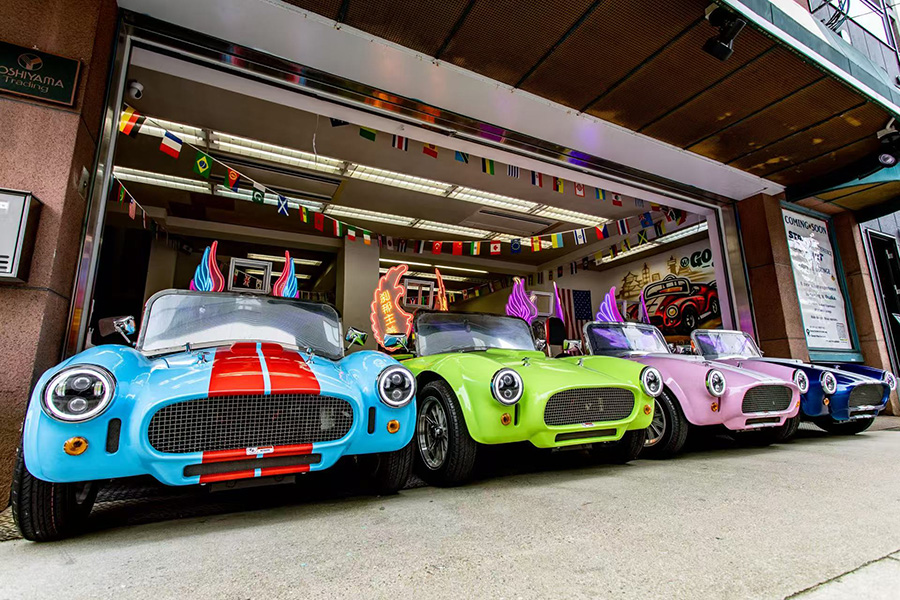
If you search Osaka go cart, the motorized-vehicle spelling you usually want is “go-kart,” although dictionaries also record “go-cart” as a variant and give the older word several non-motorized meanings. For this Osaka service, the important identification is not the hyphen: W Go-Kart Osaka provides guided electric go-kart sightseeing on public roads from a staffed Shinmachi base. It is not a handcart, stroller, kart sale, solo rental or race session.
Once the intent is clear, use the company’s official service overview rather than judging a result only by spelling. A genuine match should show the Shinmachi address, two mapped city loops, guide-led format, current time/price bands, accepted driving documents and a booking path. Those facts prove that the visitor found the right activity.
Osaka go cart and go-kart can point to different meanings
Oxford’s learner dictionary lists “go-kart” and also notes “go-cart,” while Merriam-Webster defines the hyphenated word as a small motorized vehicle and gives “go-cart” additional meanings such as a walker, stroller, handcart or light carriage. That language history explains why an open-web search can produce mixed results. It does not determine how a specific Osaka operator works.
The hyphenated spelling most clearly signals the motorized vehicle
“Go-kart” is the spelling W Go-Kart Osaka uses in its brand. It immediately separates the service from a shopping cart or luggage trolley. The alternative search phrase can still express the right intention, but the reader should confirm the vehicle and experience on the destination page before booking.
The word kart does not automatically mean racing
Many dictionary examples and venues connect go-karts with racing. W Go-Kart Osaka describes a different application: guided sightseeing on Japanese public roads. The guide, traffic lights, mapped landmark routes and return to a city storefront define the product. A spelling definition should not override those first-party facts.
The phrase go cart does not mean a vehicle is for sale
The website publishes service prices by start time, not vehicle prices or product specifications for purchasers. There is no model catalogue, shipping information, ownership transfer or wholesale offer. A customer buys an approximately one-hour guided experience; the company retains and operates the karts as part of that service.
Different spellings in a travel group do not create different tours
One friend may message “go cart,” another “go-kart,” and a third “karting.” They can still be discussing the same W Go-Kart Osaka service. Before anyone sends payment, replace those loose words with the shared product identity: Castle or Tsutenkaku guided loop, selected start, Shinmachi check-in and individually licensed drivers. This prevents the group from agreeing on a word while imagining three different activities.
The organizer should also copy the canonical page and address into the group plan. A marketplace listing, map pin or social post using a similar spelling should not become the booking authority unless it resolves to the operator’s real service details. Language variation is harmless once the factual destination is consistent.
The first Osaka go cart identity test is the Shinmachi base
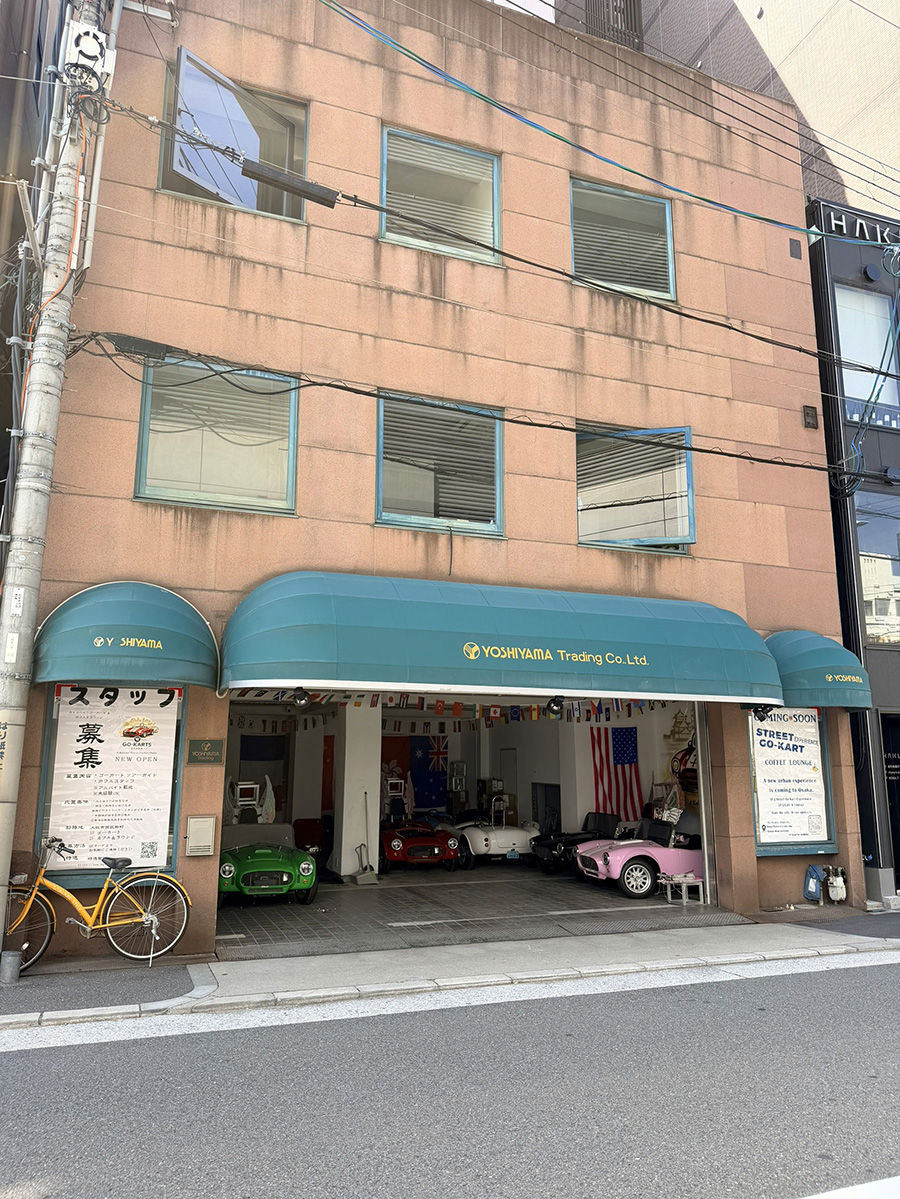
W Go-Kart Osaka operates from 3 Chome-5-2 Shinmachi, Nishi Ward, Osaka 550-0013. The site shows a real storefront, reception, lounge and karts indoors. Published walking estimates are three to five minutes from Nishiohashi, eight to ten minutes from Nishi-Nagahori and about ten minutes from Shinsaibashi.
Namba and Osaka Castle are not alternative meeting points
The city route travels through or near Namba, and the daytime loop travels around the wider Osaka Castle area. Both begin and end in Shinmachi. A search phrase containing a famous district can describe what the customer hopes to see, but only the published address tells the driver where to arrive.
The staffed reception turns a vehicle into an organized service
Guests are asked to arrive ten minutes before the selected start. Staff check documents, prepare the group and provide a safety briefing before the guide leads the route. The lounge supports that transition. This company infrastructure is one of the strongest reasons to choose the service: visitors do not collect an unknown cart from a roadside location.
The shop display does not publish fleet capacity
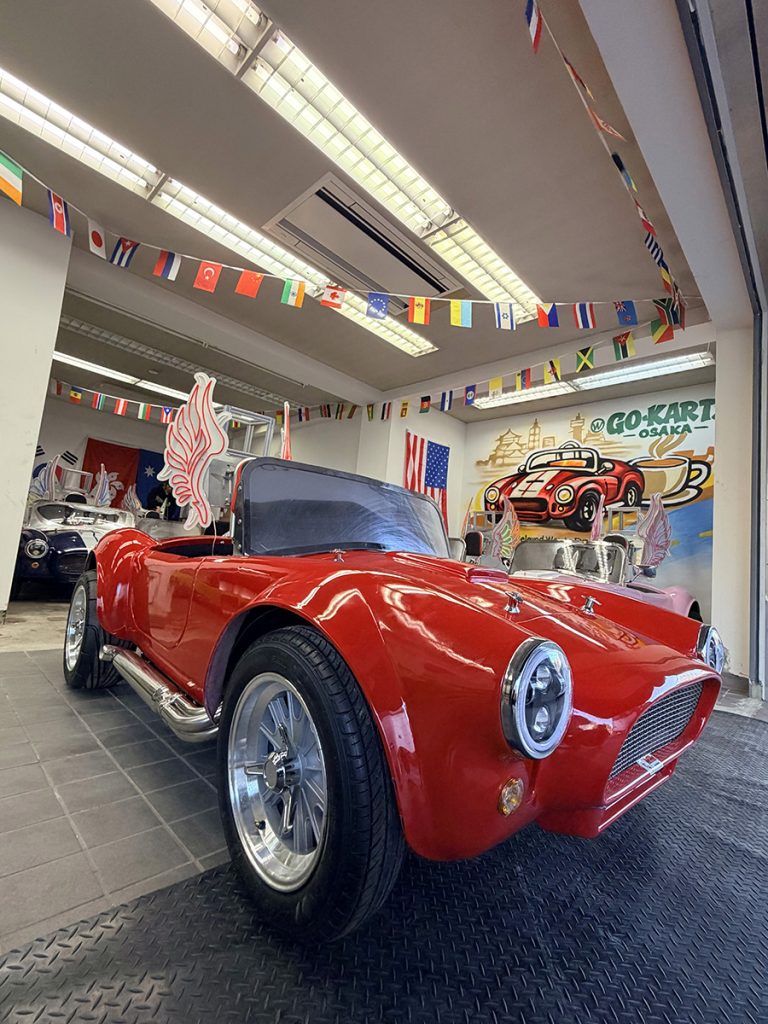
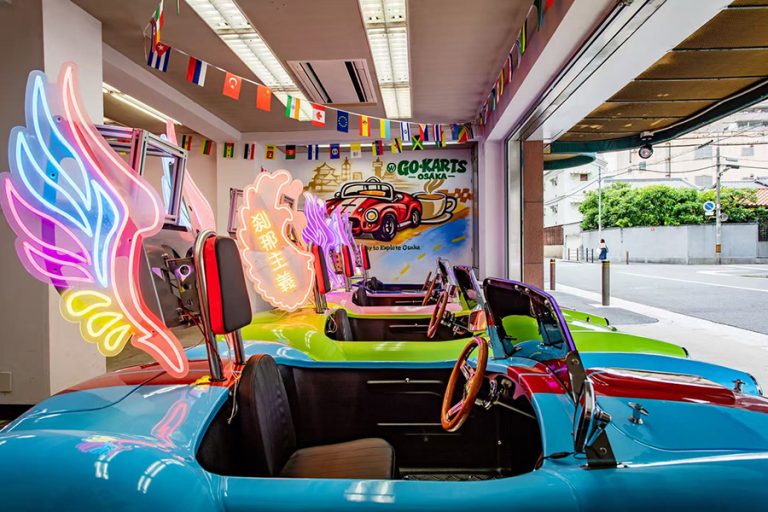
Authentic site images show several electric karts. The booking form displays intended guest counts from one through seven. Neither fact proves that seven karts are open at every hour, and no article should invent fleet size, spare capacity or a group guarantee. Actual availability belongs to the live booking process.
The second identity test is guided public-road sightseeing
The company describes an approximately one-hour experience with insurance, a guide and costume included in every price band. Drivers follow Japanese traffic law and guide instructions. Photography while driving is prohibited. These details distinguish the service from casual rental and from a track where competitors repeat a closed circuit.
A guide leads the route instead of handing over navigation
Customers do not need to invent a city course while seated in an unfamiliar open kart. They receive a briefing and follow the guide on one of the published loops. That structure supports international sightseeing while also requiring group discipline: a participant cannot turn away, stop for an attraction or pursue a personal route.
Japanese road rules remain part of the experience
The activity takes place among real road users. Drivers travel on the left, respond to traffic lights and maintain attention. A costume or compact vehicle does not make road law optional. The street-tour service definition explains why public-road responsibility, not competitive speed, is the correct expectation.
A track buyer should use the category distinction before paying
A visitor wanting lap timing, a controlled racing line and performance comparison should select a track-based product. W Go-Kart Osaka does not publish lap records, maximum speed, motor power or racing instruction. The public-road tour versus track guide makes this non-fit transparent rather than promising the wrong thrill.
The third identity test is a choice between two real loops
The operator publishes a daytime-recommended Osaka Castle route and a night-recommended Tsutenkaku city route. These are not names inserted only for promotion; the site provides mapped distance and approximate driving-time context for each loop.
The Castle loop supports a daytime city view
The Castle map depicts approximately 12.6 kilometres and 48 minutes from and back to Shinmachi. It suits visitors who prefer daylight and the wider historical landmark context. It does not include museum admission, a guaranteed stop at the castle or a traffic-independent 48-minute promise.
The Tsutenkaku loop connects the Minami night districts
The city map depicts approximately 8.9 kilometres and 46 minutes through or near Amerikamura, Shinsaibashi, Dotonbori, Namba/Nipponbashi, Ebisucho and Shinsekai/Tsutenkaku. It is recommended at night. Passing those districts does not create individual attraction tickets or a Namba drop-off.
Route measurements should never become invented performance data
Distance divided by time produces an average but says nothing reliable about maximum speed, acceleration or battery range. Traffic lights and road flow matter. The company calls the karts electric but does not publish the engineering specifications that would support technical comparisons.
The fourth identity test is transparent service pricing
Hourly starts from 10:00 through 16:00 cost JPY 7,000. Starts at 17:00, 18:00 and 19:00 cost JPY 10,000. The Night Experience at 20:00, 21:00 and 22:00 costs JPY 13,000. All include the approximately one-hour experience, insurance, guide and costume.
Before 20:00, three extras remain optional
Coffee costs JPY 500, a speaker JPY 500 and a 360 camera JPY 1,000 for morning/afternoon and evening services. A driver can choose the core route without assuming that all visible equipment is bundled. Verify the actual amount shown in the reservation flow.
From 20:00, the extras are included in the night package
The JPY 13,000 Night Experience includes coffee, speaker and 360 camera. It does not publish a faster kart, longer duration or different vehicle specification. The full price and inclusion guide compares the bands on the same basis.
Stripe handles online payment without defining the vehicle category
The commercial disclosure says online payment is processed through Stripe, while cash and other electronic methods may be available for onsite reservations. Completing payment purchases the selected tour service. It does not convert the transaction into a kart rental deposit or ownership purchase.
Driver documents confirm that this is a road service
Every intended driver must bring an accepted original set. The three published paths are a valid Japanese licence; an original 1949 Geneva Convention IDP plus original domestic licence and passport; or, for Switzerland, Germany, France, Belgium, Monaco and Taiwan, an accepted Japanese translation plus original licence and passport.
One valid driver cannot lend documents to the party
A group uses one route and may use one booking lead, but eligibility stays individual. Count only people who will arrive with their own complete set. The form’s one-to-seven selector is not a passenger product, shared licence or availability guarantee.
Closed-toe shoes complete the physical preparation
The operator requires closed-toe footwear and comfortable clothes. A driver should choose an outfit that works with the open cockpit and staff instructions. The included costume does not override safe footwear or justify loose clothing that interferes with control.
The meeting-point check should occur before the hotel door closes
Place the original documents, booking details and Shinmachi address together. The shop access guide helps prevent a traveller from navigating to Namba or the route itself. Arrive ten minutes early rather than trying to solve a spelling, location or document problem at the start time.
Use the spelling variant to reach the correct booking decision
A customer who typed “go cart” does not need to change the travel goal; the customer needs to verify the page. Confirm the W Go-Kart Osaka brand, Shinmachi address, guided public-road wording, Castle or Tsutenkaku route, chosen price band and one complete document path per driver.
The booking page should reflect one coherent product
Open the official reservation form and align name, email, date, start, guest count and route/tier. If the expectation is racing, vehicle purchase, solo rental, Namba pickup or passenger seating, stop—the expected product does not match the published one.
The 48-hour policy makes expectation checking worthwhile
Customer cancellation is free until 48 hours before the scheduled tour. Inside 48 hours, cancellation is non-refundable, and rescheduling depends on availability. Severe or unsafe weather cancelled by the operator follows the published refund or no-cost-reschedule remedy. Resolve the service identity before that commercial boundary.
Service and spelling information checked on 24 August 2026: spelling context comes from established dictionaries; all operator claims come from W Go-Kart Osaka pages and media. Address, routes, prices, inclusions, documents, arrival and policies were checked. No vehicle sale, solo rental, passenger product, speed, battery, fleet or race claim is made.
Spelling can open the door, but four facts identify what is behind it: a staffed Shinmachi base, guided public-road operation, two mapped sightseeing loops and transparent service bands for eligible drivers. When those facts match the trip, “Osaka go cart” has led to the right place. W Go-Kart Osaka then has a credible service story to tell—real electric karts, real routes and a clear operating process, without needing invented performance claims.