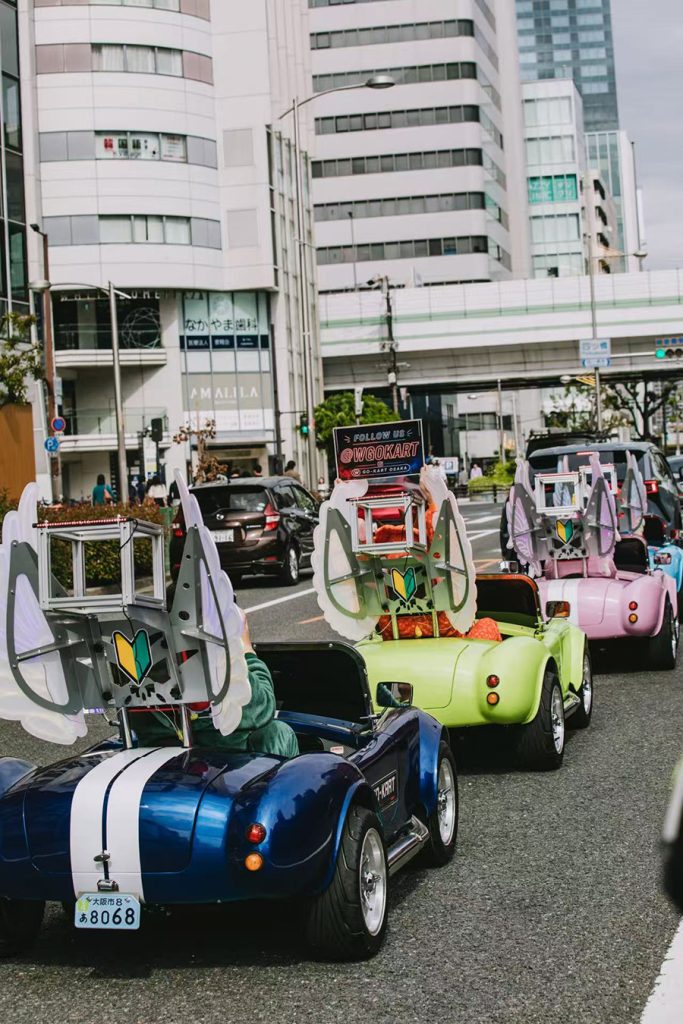
An Osaka sightseeing go kart adds value when a visitor wants to participate in the city rather than only travel between destinations. W Go-Kart Osaka provides an approximately one-hour, guide-led electric-kart loop on public roads from its Shinmachi base. The guest controls the kart, sees streets from a low open position and returns to the same shop. Trains and subways remain the better tool for efficient transport across a larger itinerary.
The choice is not kart or public transport for the whole trip. A strong plan uses Osaka Metro or rail to reach Shinmachi, the kart for one active Castle/day or city/night chapter, and walking for detailed food, shopping or attraction time. The driver must have accepted originals, arrive early, follow traffic rules and accept weather exposure. A non-driver should choose the transport-and-walking route instead.
An Osaka sightseeing go kart and a train do different jobs
Official Osaka tourism describes a well-developed transport network connecting Kita, Minami and other parts of the city. The Osaka Metro route map is designed around lines and stations. W Go-Kart Osaka’s maps are designed around guided sightseeing loops. Comparing them as if both were transport tickets hides the reason a visitor might pay for the kart.
| Visitor job | Metro, rail or walking | W Go-Kart Osaka |
|---|---|---|
| Reach a destination | Moves the traveller between selected stations/places | Returns to the Shinmachi start; no one-way transfer |
| Participation | Traveller is generally a passenger or pedestrian | Eligible guest controls an individual electric kart |
| Route | Traveller chooses connections | Guide leads one published sightseeing loop |
| Entry threshold | Relevant fare/access rules | Accepted original driving documents, briefing and road readiness |
| Weather | Depends on the transport/walking stage | Outdoor road operation may change in unsafe conditions |
| Depth | Walking can support extended stops | Moving approximately one-hour city perspective |
The kart sells participation instead of destination efficiency
The driver steers, observes signals and follows the guide through a mapped city experience. That physical participation is the product’s differentiator. W Go-Kart Osaka does not publish speed, acceleration or performance comparisons with other vehicles, so the value should not be expressed through racing numbers. It lies in active road-level engagement.
The train solves distance that the loop does not claim to solve
A one-hour kart service is not designed to cover every Osaka district or deliver a guest to the next hotel. The route returns to 3 Chome-5-2 Shinmachi. Public transport can carry the visitor onward after the experience. Using it does not weaken the kart purchase; it allows the tour to remain an experience instead of an inefficient substitute for ordinary mobility.
Walking supplies the pauses a road loop cannot promise
Restaurants, museums, shops and deliberate photographs require time on foot. The kart maps name landmark or district context, but no admission or stop at every place is included. A traveller can notice a district from the route and return later. The combination produces movement first and depth second.
A transport window and a kart cockpit ask for different attention
A passenger can look away from the railway direction, check a phone or discuss the next station because someone else operates the train. The kart driver cannot treat the city as passive scenery. Signals, pedestrians, the guide and nearby vehicles remain part of the view. This higher participation can make a short route feel more personally involving, but the site publishes no memory study or satisfaction guarantee. The buyer should choose it because active attention is appealing, not because a universal result is promised.
The approximately one-hour loop cannot inherit a network’s coverage
Osaka Metro and rail connect many areas because mobility is their primary job. W Go-Kart Osaka deliberately offers two finite loops. The visitor should not expect the kart to add Umeda, the bay area, an airport connection or every station encountered during the wider trip. Keeping that geographic limit visible protects the experience from a false “see all Osaka” expectation and leaves the public network available for everything outside the chosen Castle or city chapter.
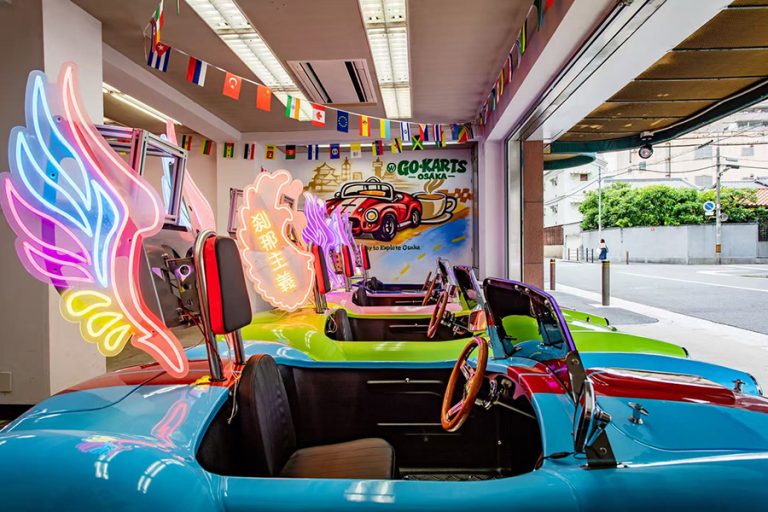
The open road creates both the view and the responsibility
An open kart reduces the separation between visitor and street, but the website does not publish a field-of-view measurement, seating height or comfort test. The honest claim is qualitative: site photographs show an open, low cockpit and the route takes place in real Osaka traffic. The same closeness that makes the scene engaging also makes attention non-negotiable.
Signals and pedestrians become part of the sightseeing rhythm
On a train, the passenger does not decide how to respond to a crossing. In the kart, the driver keeps left, obeys signals and gives pedestrians the required priority while following the guide. Stops in traffic are not lost sightseeing time; they are part of operating in the actual city rather than a simulated street.
Weather reaches the driver instead of remaining outside a window
The operator says light rain may allow tours and rain gear may be provided. Severe or unsafe weather can lead to cancellation with refund or no-cost rescheduling under current terms. A buyer who values a protected, predictable environment may prefer indoor attractions and transport. A buyer who welcomes outdoor conditions should still preserve a fallback.
The phone stays away even when the view is close
W Go-Kart Osaka prohibits taking photos while driving and says suitable stopped moments may allow pictures with possible guide help. National Police Agency guidance also warns against phone use in motion. The optional or included 360 camera supports memories only under staff direction; it does not make a handheld screen compatible with active sightseeing.
Two loops offer different kinds of city participation
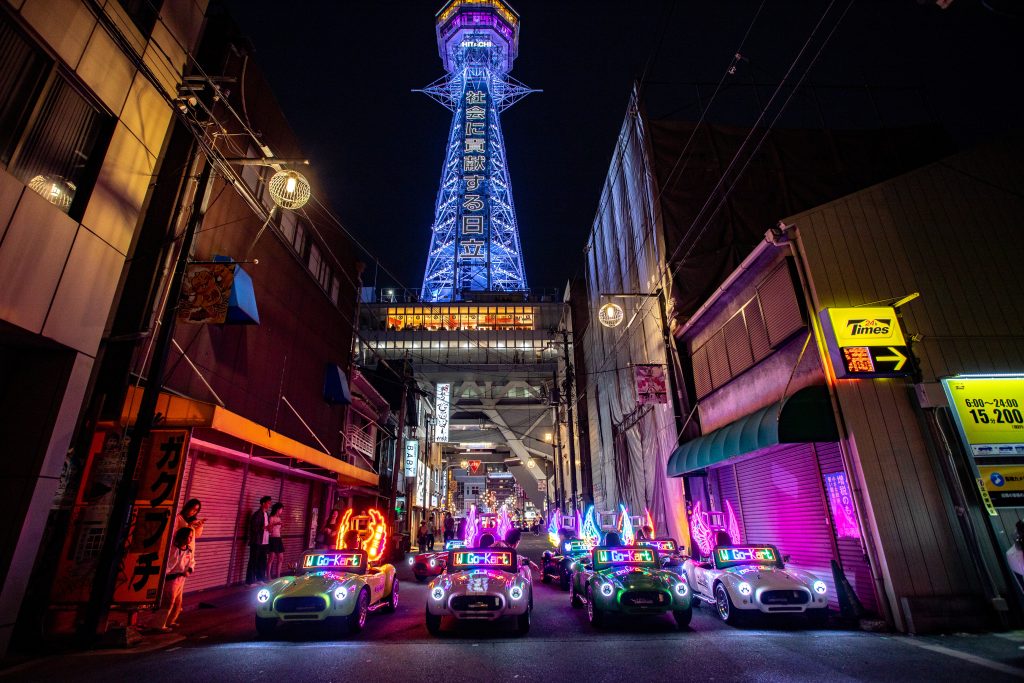
The daytime-recommended Castle loop is mapped at approximately 12.6 kilometres and 48 minutes. The night-recommended Tsutenkaku city loop is mapped at approximately 8.9 kilometres and 46 minutes. Each sits inside the approximately one-hour service and returns to Shinmachi. The route-view comparison helps match the experience to the visitor’s missing perspective.
The Castle loop adds a daytime landmark chapter
This choice can complement a trip already rich in shopping and nightlife. It gives the kart a broad historical-city orientation without including museum entry or park exploration. A traveller can use rail or Metro for the rest of the day and plan any Castle visit independently after returning to the shop.
The city loop adds Minami and Shinsekai after dark
The route travels through or near Amerikamura, Shinsaibashi, Dotonbori, Namba/Nipponbashi, Ebisucho and Shinsekai/Tsutenkaku. The experience links those districts as a moving night view. It does not replace walking through Dotonbori for food or entering Tsutenkaku; those remain separate activities.
Mapped minutes do not make either loop a transport schedule
Forty-eight and 46 minutes are approximate map context. Reception, briefing, traffic and return handling surround them. A visitor cannot calculate a station departure by adding the printed number to the start time. Onward transit should be planned from Shinmachi with recovery margin.
Eligibility separates active drivers from sightseeing companions
Every kart driver needs one complete accepted path: a valid Japanese licence; an original 1949 Geneva Convention IDP, original domestic licence and passport; or an accepted foreign licence, authorized Japanese translation and passport for a listed jurisdiction. A digital permit or a friend’s documents cannot qualify another participant.
A non-driver has a better Osaka plan outside the kart
The site does not publish a passenger seat or spectator vehicle. A companion who lacks valid documents should not be counted on riding along. Public transport, walking and independent attractions give that person a real sightseeing day. The drivers can meet them after the Shinmachi return without asking the operator to invent a product.
A nervous but eligible beginner must judge road readiness
No previous kart experience is required, and the site says guides support beginners. That does not convert the tour into a driving school or guarantee confidence. The beginner should arrive early, ask about controls and accept public-road responsibility. The road-responsibility guide makes the operating threshold clear.
A seasoned driver still follows the operator’s route
Experience may make left-side traffic familiar but does not turn the kart into a rental. Personal shortcuts, spontaneous stops and overtaking are outside the published guide-led service. An experienced guest gets the best value by using skill to remain calm and attentive while letting the guide organize the city sequence.
A mixed-transport day makes the kart easier to appreciate
Use the Metro or rail to reach Shinmachi calmly
The shop publishes walk estimates from Nishiohashi, Nishi-Nagahori and Shinsaibashi stations. The Shinmachi access guide separates platform-to-street travel from the ten-minute early-arrival target. Hotel-door time should include the line, transfer, exit and walking stage.
Use the kart hour for a view public transport is not selling
Once checked in, stop judging the tour by how many destinations it transports you to. The guide, electric kart, route and active road position are the value. A route may pass a place the visitor later reaches much faster by train; that efficiency difference is irrelevant because the products are doing different jobs.
Use walking after the return for the chosen detail
After Castle/day, the visitor may choose a longer landmark visit. After city/night, they may return to Dotonbori or Shinsekai for food and photographs. The tour becomes an orientation and memory, while walking becomes investigation. This sequence avoids demanding that a moving group stop whenever one person becomes curious.
The package price should be compared with an experience, not a fare
Daytime starts from 10:00 through 16:00 cost JPY 7,000; 17:00–19:00 cost JPY 10,000; and the 20:00–22:00 Night Experience costs JPY 13,000. All include approximately one hour, insurance, guide and costume. Coffee, speaker and 360 camera are separate before 20:00 and included at night.
A transit fare buys transport rights under its own terms. The kart price buys a scheduled, staffed public-road experience. Comparing the two numbers without comparing their jobs would be misleading. Evaluate whether active driving, the chosen route and guide-led structure deserve a place in the trip, then use the booking form for live availability.
Choose the Osaka sightseeing go kart for one active memory
The strongest fit is an eligible, sober visitor who wants to control an electric kart, follow a guide and experience either daytime Castle context or the southern city after dark. The weakest fit is a non-driver, a traveller with no weather flexibility, someone needing a hotel transfer or a creator who cannot put the phone away.
Customer cancellation is free until 48 hours before the tour. Inside that boundary it is non-refundable, and rescheduling depends on availability. Read the published terms before fixing adjacent tickets. Then let public transport do what it does well before and after the kart.

Comparison information checked on 24 August 2026: format, routes, map measures, base, access, documents, photo guidance, weather, prices and policies were checked on W Go-Kart Osaka pages. Osaka Metro and official tourism support only general city-mobility context. No speed, comfort, field-of-view, fare advantage, travel-time saving, exact view or weather outcome is claimed.
Osaka does not need one sightseeing tool to do every job. Use the network to move, feet to explore and W Go-Kart Osaka to create a concentrated hour of active city perspective. The service is good because its role is clear: a real base, real guide, real electric kart and mapped road loop give an eligible visitor a memory that a necessary train journey was never designed to provide.