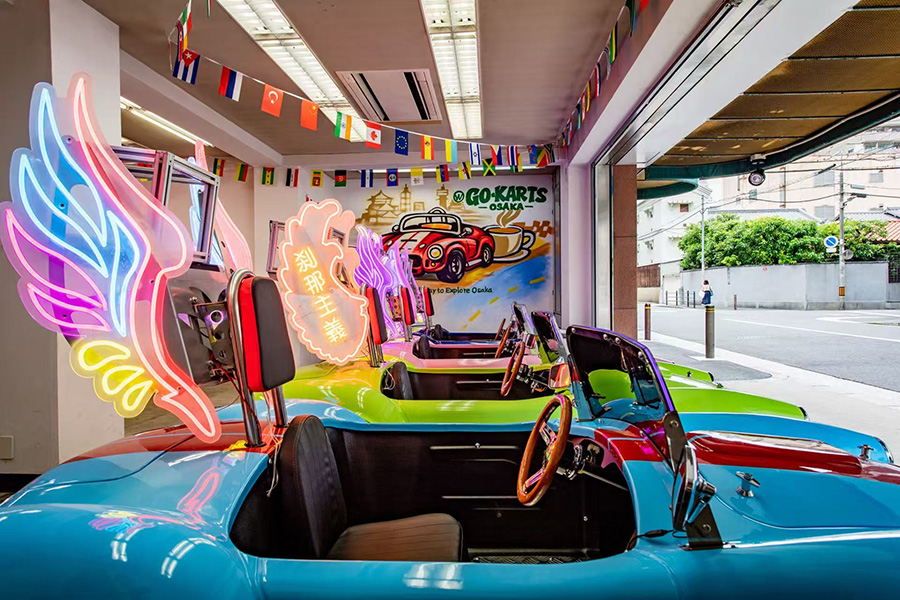
A street go kart Osaka booking at W Go-Kart Osaka places an individual electric kart on ordinary public roads behind a guide. That changes the entire purchase. Drivers need an accepted original licence set, arrive ten minutes early for checks and a briefing, keep left, obey signals, watch pedestrians, remain sober and leave the phone alone. The guide supplies direction; the guest still controls the kart.
This service best fits a visitor who wants the excitement of a low, open city view and accepts the discipline of real traffic. It does not fit someone seeking a closed track, competitive driving, independent route choice or a mobile filming session. Start with the operator-specific street-driving guide, then decide whether the responsibilities feel as attractive as the pictures.
Street go kart Osaka responsibility is divided three ways
The operator, driver and road environment each control different parts of the experience. Confusing those roles creates risky expectations. A guide cannot make a driver’s legal documents valid, and a driver cannot make a public signal change for the group. The following split shows where the service ends and personal responsibility begins.
| Part of the experience | What W Go-Kart Osaka publishes | What the driver must supply | What remains outside either promise |
|---|---|---|---|
| Before departure | Staffed reception, document check and briefing | Valid originals, early arrival, suitable clothing and attention | Hotel travel delays or missing documents |
| On the route | Guide-led mapped public-road loop | Vehicle control and compliance with road rules | Signals, traffic flow and other road users |
| Images | Published 360-camera option/inclusion by time band | No handheld photography while driving | A guaranteed landmark frame or empty street |
| Weather | Operator decision and published refund/reschedule terms | Appropriate preparation and communication | A specific forecast or guaranteed operation |
The operator provides structure rather than remote control
W Go-Kart Osaka publishes two routes, an approximately one-hour format, a guide, insurance, a costume and a common Shinmachi base. These elements turn individual karts into one sightseeing service. They do not remove steering, braking or observation from the person in the seat. Following the guide remains an active driving task.
The driver brings legality and moment-to-moment attention
Each guest needs their own qualifying document path. Once approved, the person must continue to read signals, position the kart correctly and respond to conditions. Confidence earned in a full-size rental car may help, but it does not justify skipping the briefing or assuming the kart will feel identical.
Traffic makes the map flexible without erasing the route
The Castle map shows approximately 12.6 kilometres and 48 minutes; the Tsutenkaku city map shows approximately 8.9 kilometres and 46 minutes. Those are useful route descriptions, not guarantees of constant movement. Signals can interrupt formation, pedestrians can require yielding and traffic can change rhythm while the guide still maintains the chosen loop.
The low kart viewpoint changes familiar driving cues
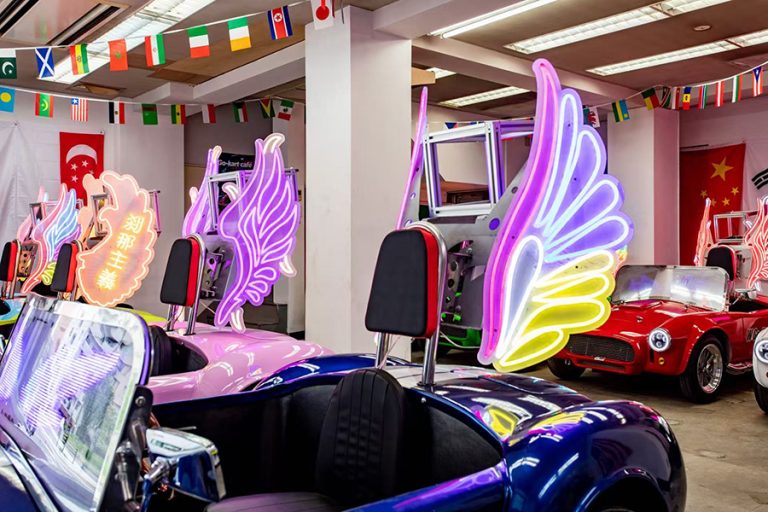
The website’s cockpit photograph shows a steering wheel close to the open road and a much lower seating position than a conventional passenger vehicle. W Go-Kart Osaka does not publish dimensions, performance data or comparison tests, so those should not be invented. The honest implication is simpler: the visual experience is distinct, and the driver should use the briefing to adapt rather than rely on assumptions.
A rental-car veteran still needs the kart briefing
A visitor may already understand left-side travel yet be unfamiliar with the kart’s controls, sight line and group sequence. Arriving ten minutes before the selected start allows staff to connect that general road experience with the actual vehicle. Asking a control question at reception is better than discovering uncertainty after the group has moved.
Closed-toe shoes support the control task
The operator asks for closed-toe shoes and comfortable clothing. This is not a costume-style suggestion: the driver needs an unobstructed relationship with the controls. Loose, impractical footwear or clothing chosen only for photos can undermine the reason for the guidance. Select appearance around driving, not driving around appearance.
An open view increases interest and the need to prioritise
Signs, buildings, friends and street activity are close to the driver’s field of attention. That sensory access is a major appeal of the product. It is also why the road must win every competition for attention. A memorable landmark can be seen without turning it into a handheld photo at the same moment.
Five public-road decisions happen after the briefing
A briefing cannot predict every signal phase or pedestrian movement. Its purpose is to give the driver a framework that survives those changes. The visitor should know in advance how to respond when the attractive city scene and the ordinary road task ask for attention at once.
Enter the left-side flow without copying blindly
National Police Agency guidance tells drivers that vehicles travel on the left in Japan. Following the guide helps orientation, but the kart ahead is not a substitute for observing the lane, signals and immediate surroundings. A driver checks the real road before reproducing anyone else’s movement.
Let a signal separate the line instead of forcing a catch-up
If a light changes, the safe response is to obey it rather than accelerate through or chase the group. The guide-led format is designed around ordinary traffic, so temporary spacing must be treated as normal. A visitor who believes the group must remain visually continuous at any cost has imported a closed-course assumption onto a city street.
Give a pedestrian crossing priority over group symmetry
Official guidance requires drivers to stop and give way when pedestrians are crossing or about to cross as applicable. A neat formation has no priority over a person using the crossing. The guest should observe the road directly and respond, even when the kart in front has already proceeded.
Keep the phone inactive when a famous view appears
The National Police Agency warns that smartphone use prevents drivers from detecting hazards and directs necessary use to a safe place after stopping. W Go-Kart Osaka explicitly says not to take pictures while driving. Content creators should work within the arranged 360-camera option or approved non-driving moments, not improvise a handheld recording.
Follow staff direction when conditions change
Light rain may permit the service and rain gear may be available, while severe or unsafe weather can lead the operator to cancel. The driver should not make an independent “the road looks fine” decision against operational communication. The guide sees the group and current route situation as a service, not only one person’s willingness.
Real-road eligibility begins with physical originals
A valid Japanese driving licence is one accepted path. Many visitors instead need an original international driving permit issued under the 1949 Geneva Convention, their original domestic licence and passport. Visitors using the translated-licence route need the accepted original foreign licence, an authorized Japanese translation and passport for a jurisdiction listed by the operator.
A digital permit is not a convenient fallback
The National Police Agency’s IDP guidance says the original paper permit is required and a digital version on a phone is not acceptable. W Go-Kart Osaka checks documents at the base. A screenshot, scan or forgotten passport cannot be “made safe” by a good driving record in another country.
Eligibility cannot be borrowed from a friend
Each driver operates a separate kart, so each driver supplies their own document set. The website does not publish a passenger product or on-route driver swap. If one person is not eligible, reduce the driving party and give that friend another plan rather than ask staff to convert the activity at check-in. The document guide helps settle this before payment.
Late arrival creates pressure at the wrong stage
Turning up at the selected start time instead of ten minutes early leaves less room for originals and questions. A guest should not respond by rushing staff or skipping explanations. The arrival-to-return walkthrough shows why reception and briefing are part of the service rather than delays before the “real” activity.
Route and time choices can reduce avoidable pressure
W Go-Kart Osaka recommends the Castle loop during daytime and its Tsutenkaku city loop at night. Choosing the route that matches the desired view reduces the temptation to hunt for a missing visual moment while driving. Choosing a start with time on both sides reduces the temptation to hurry through check-in or chase an onward reservation.
The Castle loop suits a driver who wants daytime orientation
The approximately 12.6-kilometre map creates a broader route identity around the Castle context. It should be selected for that moving daytime chapter, not for a promise of admission or parking. A separate attraction visit can absorb detailed photography and history after the kart has returned to Shinmachi.
The city loop suits a prepared night driver
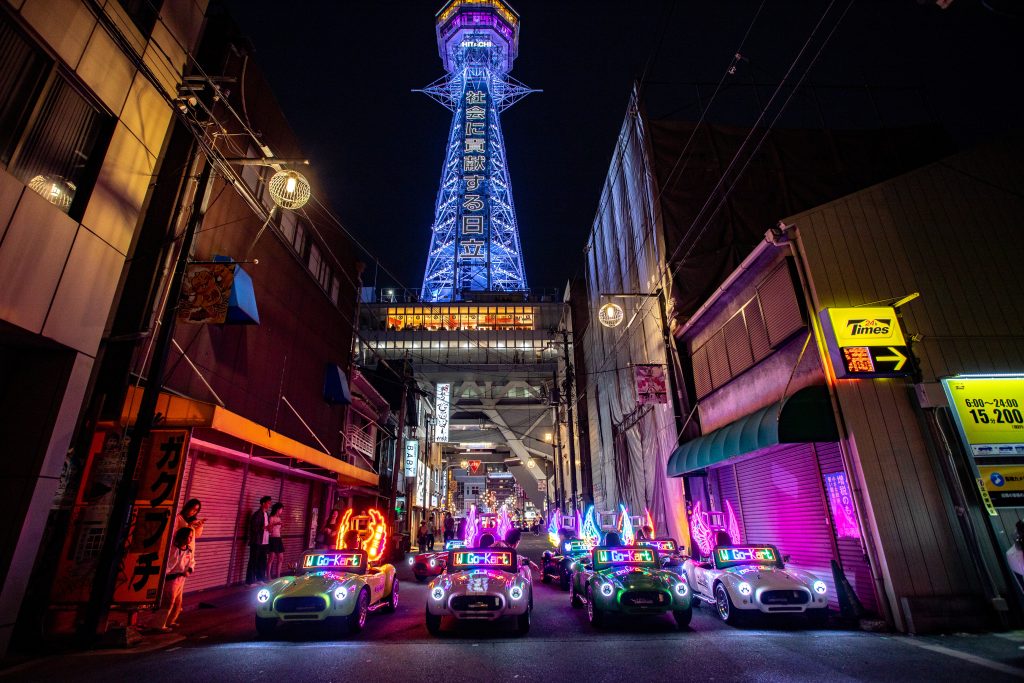
The approximately 8.9-kilometre route travels through or near Minami and Shinsekai districts and is recommended at night. Illuminated streets create more visual stimulus, while the same signals and phone restrictions remain. A sober, rested driver who welcomes that balance is a better fit than someone already deep into nightlife.
The Shinmachi return belongs in every onward calculation
Neither route drops guests at Castle, Namba or Tsutenkaku. A late dinner or train begins after the group returns to 3 Chome-5-2 Shinmachi and completes the service. The two-route view comparison keeps both the visual difference and the common return point visible.
A street go kart Osaka price includes the operating frame
Daytime starts from 10:00 through 16:00 cost JPY 7,000, starts at 17:00–19:00 cost JPY 10,000, and the 20:00–22:00 Night Experience costs JPY 13,000. Approximately one hour, insurance, the guide and a costume are included at every band. That guide-and-insurance inclusion matters on a real-road product.
The camera option does not buy permission to hold a phone
Before 20:00, coffee and a speaker are each listed at JPY 500 and a 360 camera at JPY 1,000. At night, the three are included. These package facts change what is supplied, not the driver’s duty. Follow staff instructions for any camera and keep personal phone use outside the driving portion.
The cancellation policy should discourage last-minute pressure
Customer cancellation is free until 48 hours before the scheduled tour. Inside that boundary it is non-refundable, and rescheduling depends on availability. These terms make early document and weather planning commercially important. Read the current disclosure before the group commits.
Book only when the public-road version is the attraction
The right buyer says yes to both sides of the product: “I want the low electric-kart view” and “I will treat it as ordinary public-road driving.” Confirm the route, original documents, sober schedule, early arrival and price band. Then use the booking form for the live date and start selection; its one-to-seven guest field is not a capacity guarantee.
A visitor who wants competition, free exploration, a passenger seat or continuous handheld filming should choose a different activity. This boundary is a mark of service clarity. W Go-Kart Osaka is offering a guided relationship with the city, and the experience works when the participant accepts the road as real rather than as a backdrop without rules.
Road and service information checked on 24 August 2026: format, route maps, arrival, documents, clothing, camera guidance, start bands, prices and policies were checked on W Go-Kart Osaka pages. NPA and Osaka Police material supports only general left-side, signal, pedestrian, smartphone and emergency context. No accident rate, remote control, safety guarantee, exact formation, route condition or staff emergency protocol is claimed.
The real road is not an inconvenience attached to the tour; it is the environment that makes the view meaningful. W Go-Kart Osaka supplies a clear base, a guide, mapped loops and visible terms. The driver completes that quality system by arriving prepared, controlling the kart, observing Osaka and letting every signal, crossing and instruction matter more than the next photograph.