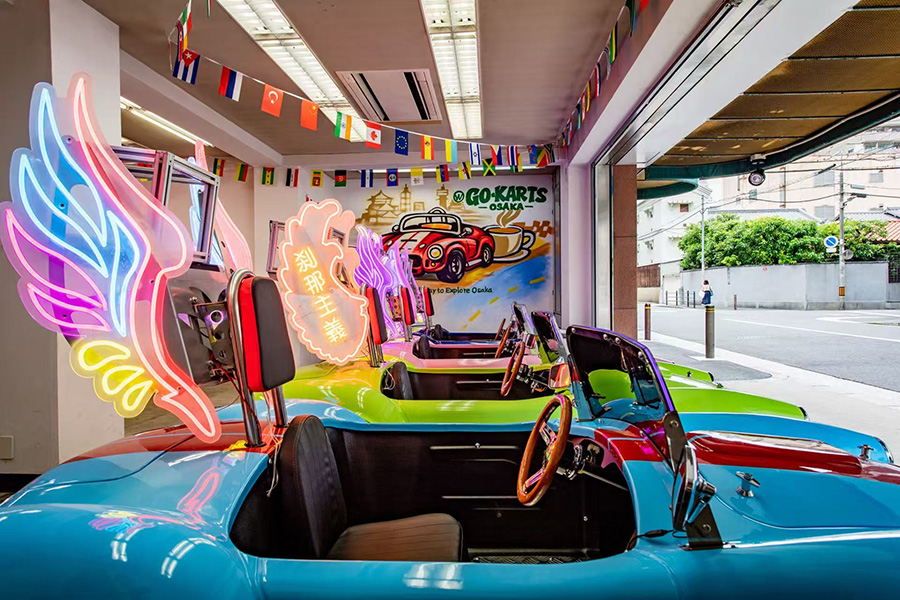
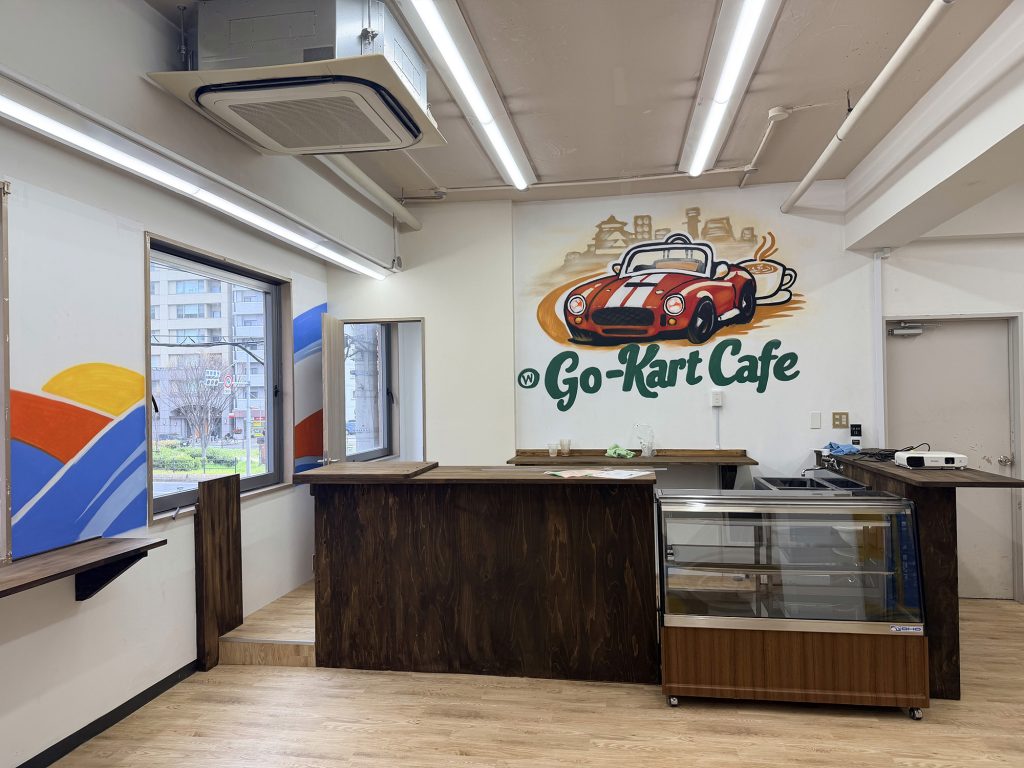
Kart Osaka can describe several very different activities, so the useful first question is not “How fast is it?” but “What service am I choosing?” W Go-Kart Osaka provides an approximately one-hour, guide-led electric go-kart sightseeing drive on Osaka public roads. Guests check in at the staffed Shinmachi base, present valid original driving documents, receive a briefing, follow a mapped city loop and return to the same shop. It is not a racetrack session, an unaccompanied vehicle rental or a passenger sightseeing ride.
This distinction tells a visitor whether the experience fits. Choose it when the aim is to drive through the city with a guide and see Osaka from a low, open kart. Do not choose it for lap timing, competitive overtaking, free route selection or a seat for a companion who cannot legally drive. The electric city-drive overview is a useful starting point for the real service.
Kart Osaka at W Go-Kart is guided city sightseeing
The product combines three elements: an individual electric kart, a guide-led group and a public-road sightseeing route. Removing any one of those elements creates a different activity. A track supplies a closed circuit and performance context. A conventional rental gives the renter wider control over destination and duration. A passenger tour carries a guest who does not operate the vehicle. W Go-Kart Osaka publishes none of those three formats.
The kart is the viewpoint, not a race machine promise
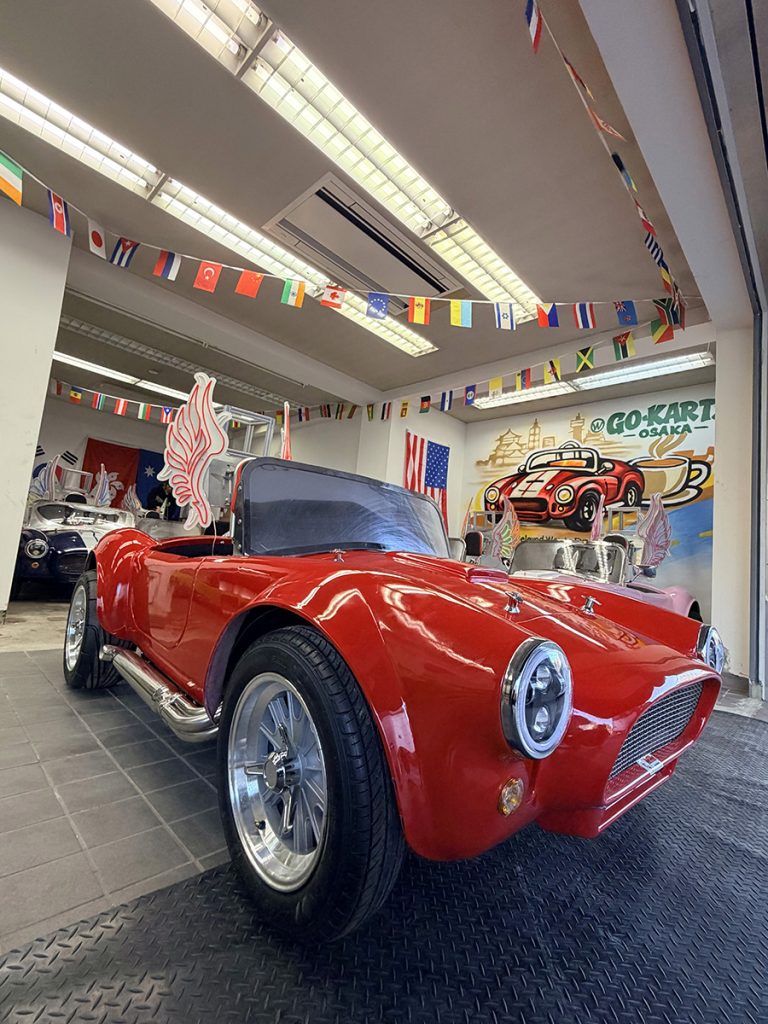
The site’s photographs show compact open karts, a steering wheel, a low seating position and illuminated styling. The operator describes them as electric and uses them on public roads. It does not publish acceleration figures, maximum speed, lap times or motorsport classes. A buyer can reasonably expect a distinctive road-level view; they should not infer racing performance that the service never claims.
The guide defines the journey instead of a free-drive rental clock
The guide leads the group around one of the operator’s mapped loops. That means the booked hour is not permission to collect a kart and improvise an itinerary. Public traffic, signals, pedestrians and group operation shape the drive. A visitor who wants to stop wherever they choose or leave the vehicle in another district needs a different type of transport service.
Every guest who drives needs their own legal document route
This is a driving activity, not a ride-along attraction. Each driver must qualify through a valid Japanese licence, the original 1949 Geneva Convention IDP set, or the accepted foreign-licence and Japanese-translation set for the jurisdictions listed by the operator. The National Police Agency also tells overseas drivers to carry the original paper permit where that route applies. A phone image does not turn a non-driver into an eligible participant.
Four expectations that do not belong in a kart Osaka booking
A clear boundary protects both satisfaction and safety. Most disappointment would begin before arrival: the buyer mentally purchases a race, rental, taxi or photo session while the operator is selling a guided drive. The following four assumptions should be corrected before a group chooses a date.
Motorsport fans should not expect timed laps or overtaking
A traveller who collects circuit experiences may enjoy the kart’s open format but should not judge this tour by racing criteria. No starting grid, lap-count package, track marshal system or competitive result is advertised. Osaka Police and JAF public-road guidance applies: drivers keep left, obey signals, yield where required and avoid smartphone distraction. The guide and road environment take priority over performance.
Independent explorers cannot replace the mapped loop with a personal route
The daytime recommendation is the Osaka Castle loop. The map shows approximately 12.6 kilometres and 48 minutes. At night, the operator recommends a Tsutenkaku city loop of approximately 8.9 kilometres and 46 minutes, travelling through or near areas such as Amerikamura, Shinsaibashi, Dotonbori, Namba/Nipponbashi, Ebisucho and Shinsekai. Those are operator routes, not suggestions that the guest may branch off alone.
A friend without the right licence does not become a passenger
The website does not publish a passenger seat, spectator package or transfer vehicle. If one friend cannot qualify to drive, the safe planning assumption is that the person cannot join the kart-driving portion. Do not book a larger party on the belief that two people can share one kart or swap at a landmark. Ask that friend to plan a separate activity and meet the drivers after they return to Shinmachi.
Route photographs do not promise stops at every landmark
The two loops are moving road experiences. A landmark on the route map is not an admission ticket, parking stop, guided walking visit or guaranteed portrait location. Guests should take in the city while following the guide and must not handle a phone while driving. A separate walking visit is the right product when detailed photos or attraction entry are the priority.
The public road changes how the kart service is delivered
Public-road operation explains several parts of the W Go-Kart Osaka process that might look unnecessary to someone imagining an amusement track. The licence check is legal preparation. The ten-minute early arrival creates room for reception and the briefing. Closed-toe shoes and comfortable clothes support vehicle control. The guide is part of the operational structure, not a decorative tour extra.
Left-side traffic and pedestrians matter more than the camera angle
Japan drives on the left. Official public guidance also requires drivers to obey red lights, respond to signs and give pedestrians appropriate priority. The operator tells guests not to take photos while driving. That creates a practical division of attention: the driver watches the guide and road, while any approved 360 camera or other recording arrangement remains secondary to control.
The briefing connects foreign driving experience to Osaka streets
A licence proves legal eligibility; it does not prove familiarity with local lane position, signs or group formation. Reception and the guide briefing bridge that gap. Arriving at least ten minutes before the selected start gives staff time to check originals and explain the operating sequence. A late arrival compresses the very preparation that makes the public-road format understandable.
Weather can change an outdoor road product
The current site says light rain may permit operation and rain gear may be available. Severe or unsafe weather can lead the operator to cancel, with a refund or no-cost rescheduling under its terms. This is not a guarantee that every wet booking proceeds. It is another difference from an indoor kart track whose surface and schedule may be isolated from city conditions.
The public-road operation guide goes deeper into the behavioural change between a circuit mindset and a city-driving mindset.
Two routes give the guided service different identities
The Castle and city loops are not simply two names for the same photograph. They place the service into different parts of a visitor’s Osaka day. Both leave from and return to 3 Chome-5-2 Shinmachi, Nishi Ward. Neither is a one-way transfer to the landmark named in the route.
The Castle loop suits a daytime landmark perspective
The operator recommends this loop in daytime, when its approximately 12.6-kilometre map creates a broader landmark-oriented drive. It suits a visitor who wants the kart to be a daytime sightseeing chapter and is comfortable arranging any detailed Castle-area visit separately. It does not suit someone expecting the kart hour to include museum admission or an extended walking stop.
The Tsutenkaku city loop suits Osaka after dark
The approximately 8.9-kilometre city loop concentrates on the Minami-to-Shinsekai character and is recommended at night. It suits a traveller choosing illuminated streets and nightlife districts as the moving backdrop. The route still returns to Shinmachi, so a later dinner or entertainment plan begins only after the group has finished at the base and travelled onward.
Mapped minutes describe the route, not an exact station connection
The published 48- and 46-minute values sit within an approximately one-hour service. Traffic signals, public-road conditions, briefing, preparation and return handling mean a traveller should not treat either number as a guaranteed release time. The one-hour route comparison helps readers compare the two experiences without converting a map into a timetable promise.
The price buys a defined service, not only vehicle minutes
From 10:00 through 16:00, the published hourly price is JPY 7,000. Starts at 17:00, 18:00 and 19:00 cost JPY 10,000. The Night Experience at 20:00, 21:00 and 22:00 costs JPY 13,000. Each band includes approximately one hour, insurance, the guide and a costume. That bundle makes the guide-led character commercially visible.
Day and evening extras remain separate before 20:00
For starts before 20:00, the current price list shows coffee at JPY 500, a speaker at JPY 500 and a 360 camera at JPY 1,000. These are choices around the tour, not upgrades that convert it into a race or private rental. Confirm the current selection at booking rather than assume every accessory appears automatically.
The Night Experience changes what is included
At 20:00–22:00, coffee, the speaker and the 360 camera are included in the JPY 13,000 package. A buyer comparing 19:00 with 20:00 is therefore comparing both time and inclusions. Seasonal darkness still varies, so the package name should not be treated as a promise of a particular sunset or crowd level.
Published policies make the service easier to evaluate
Customer cancellation is free until 48 hours before the scheduled tour. Inside that boundary it is non-refundable, while rescheduling depends on availability. W Go-Kart Osaka also publishes its address, station walk estimates, licence paths, route maps and commercial disclosure. These concrete details are stronger evidence of service clarity than unsupported superlatives about being the fastest or largest.
Three travellers can now decide whether this is their Osaka kart
The circuit collector should choose it only for city perspective
A motorsport enthusiast may still value the unusual open cockpit, electric kart and real Osaka setting. The correct mental purchase is a guided sightseeing drive governed by ordinary road responsibilities. If competitive lap data is essential, this product is mismatched; if seeing city streets from a distinct driving position matters, it can fit.
The prepared sightseeing couple matches the core service
Two eligible drivers who want a shared route can select the Castle/day or city/night identity, bring their individual original documents and arrive early together. They should choose a start based on route and package rather than chase an imagined performance difference. The licence requirement guide lets each person verify the correct paperwork before payment.
The mixed group needs a plan for anyone who cannot drive
If three friends are interested but only two have valid document sets, the booking should reflect eligible drivers rather than total companions. Because no passenger or spectator product is published, the third friend needs an independent plan. This is a service boundary, not evidence that the operator can make an exception at reception.
From a Kart Osaka idea to a correct booking choice
First, decide whether guided public-road sightseeing is genuinely the desired product. Second, confirm every driver’s licence route using originals—not screenshots or translations from unapproved sources. Third, choose Castle/day or Tsutenkaku city/night. Fourth, compare the current price and inclusion band. Only then should the group use the booking form to select date, time and guest count.
The form currently offers dates, hourly starts, route/price selections and a guest selector from one to seven. That selector is not a published fleet-capacity promise, and submission should not be interpreted as permission to substitute an ineligible driver. Read the commercial terms, preserve the 48-hour boundary and keep the physical documents ready for check-in.
Service information checked on 24 August 2026: format, routes, mapped measures, hours, prices, inclusions, address, arrival guidance, licence paths and policies were checked on W Go-Kart Osaka pages. NPA, Osaka Police and JAF material informs only general legal and public-road context. No racing performance, independent rental, passenger seat, route stop, fleet size, exact finish, language or weather outcome is claimed.
Choose W Go-Kart Osaka because its real product fits the trip: a staffed base, a clear document check, an electric kart, a guide and a mapped city loop. That combination can be memorable precisely because it is not pretending to be a racetrack. Once every driver accepts the public-road responsibility and selects the city view they actually want, “kart in Osaka” becomes a specific, bookable sightseeing experience rather than a vague expectation waiting to disappoint.